Home·Our Surgeons·Dr Mohamed Mohamed
Medical Director
Dr Mohamed Mohamed.
Medical Director of City Clinics, and the surgeon whose standards every procedure in this building is held to.

At a glance
- Medical Director, City Clinics, 82 Harley Street, London
- GMC-registered: GMC number 7366953
- MBBS · MSc · BSc (Hons)
- More than a decade in medical and surgical practice
- 5,632+ FUE procedures to date, one patient a day
- Registered Manager and Nominated Individual for City Clinics Group Limited with the Care Quality Commission
- Member of ISHRS, the Royal Society of Medicine, BACS and the Royal College of Surgeons
Dr Mohamed Mohamed is the Medical Director of City Clinics, a doctor-led hair restoration clinic at 82 Harley Street, London. He is a GMC-registered hair transplant surgeon (GMC number 7366953) with more than a decade of medical and surgical practice, who has performed 5,632+ FUE procedures to date and still takes one patient a day.
Dr Mohamed in numbers
Background and training as a hair transplant surgeon
After completing his surgical training and becoming a member of the Royal College of Surgeons, Dr Mohamed trained with some of the world's most renowned hair transplant surgeons and refined his technique in FUE surgery. He holds MBBS, MSc and BSc (Hons) degrees and has more than a decade of medical and surgical practice. As Medical Director he oversees every stage of the patient journey, from the first consultation to long-term follow-up.
How Dr Mohamed performs FUE hair transplants
A hair transplant is permanent surgery on a progressive condition, so the plan has to protect your donor supply and still look right in ten years, not just ten months. Dr Mohamed's method follows from that.
- You meet him first. If Dr Mohamed is to perform your procedure, your consultation is with him, not a patient adviser. The plan, the graft count and the quote come from him.
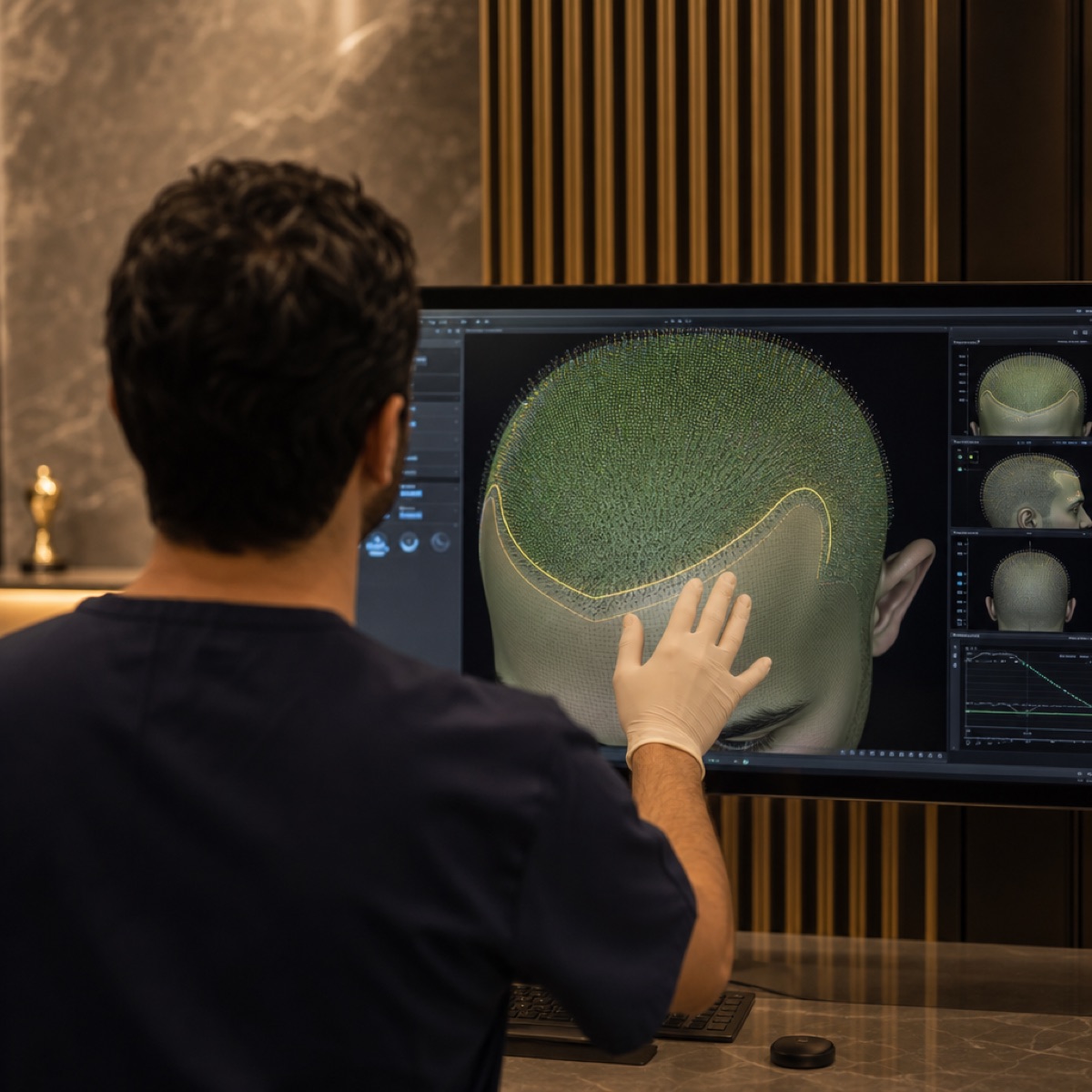
- Your scalp is measured before anything is decided. A KE-Bot 360° robotic scan takes about 15 minutes and reads more than 12,000 measurement points: follicle density, hair calibre and your true donor capacity. KE-Photo imaging supports donor assessment and the long-term monitoring of your result. The machine measures; Dr Mohamed reads the data and designs the plan.
- The plan is conservative. He plans graft numbers to protect your donor area, designs a realistic hairline, and tells you plainly when surgery is not the right answer.
- He performs the surgery. Design, extraction and placement stay in the surgeon's hands; assistants support the theatre. He takes one patient a day, so his attention is not divided.
- He follows you up. The surgeon who performed your procedure reviews you at two weeks, three, six and twelve months, as part of the £2,000 aftercare programme included in every price.
His approach in detail
These are the principles behind Dr Mohamed's plans, drawn from his February 2026 interview with The Industry Leaders and from City Clinics' published guidance.
- Donor hair is finite, so the donor area comes first. The donor area is the permanent band of hair at the back and sides of the scalp. The useful question is not how many follicles are visible there, but how many can be moved safely now while a reserve is kept for the future. Dr Mohamed uses conservative graft numbers and a thorough pre-treatment assessment so the donor area is never over-harvested.
- The hairline has to age with you. He plans every case to preserve donor supply, anticipate future hair loss and hold up in ten years, not just ten months, with a realistic, age-appropriate hairline.
- A transplant treats the baldness, not the cause. Hair loss is often progressive and usually needs long-term medical management. Not every hair loss condition is the same, so proper diagnosis comes first, and over-the-counter products cannot reverse genetic hair loss.
- Technology measures; the surgeon decides. Advanced imaging, AI-supported diagnostics and robotics-assisted analysis let him assess scalp health at a microscopic level, track the progression of hair loss and give patients measurable results.
- Safety comes before aesthetics. A good-looking result must never compromise scalp health or donor integrity, and each decision rests on evidence-based medicine and ethical practice.
- Regenerative medicine is the area to watch. Stem-cell-based therapies, exosome research and bioengineered hair follicles could change the field. Many are still in research, and he expects them to complement established surgery rather than replace it.
- Standards matter. He sees the growth of unregulated, low-cost providers as one of the biggest challenges in the field and supports higher standards, stronger regulation and continued investment in research.
- Honesty about expectations. A hair transplant is not an instant or permanent cure, and sometimes the right advice is to wait. Patients who understand their plan follow aftercare guidance better and are more satisfied with the result.
In his own words
‘If my name is attached to the outcome, then I will be the one holding the instruments.’
Dr Mohamed Mohamed, City Clinics
In interviews Dr Mohamed has made three points about his work. Hair loss is usually progressive, so a transplant is part of long-term care, not an instant or permanent cure. Medical safety comes before cosmetic ambition: a result should never compromise scalp health or donor integrity. And patients are right to expect transparency about qualifications, technology and long-term planning. He also comments on hair loss, hair transplantation, cosmetic surgery standards and patient safety. Read the full interview at The Industry Leaders (24 February 2026).
Areas of focus in FUE hair transplant surgery
Dr Mohamed leads City Clinics' FUE hair transplant service on Harley Street, London. His areas of focus include:
- FUE for afro-textured hair
- FUE correction and revision
- Scar-revision hair transplantation
The procedures City Clinics offers are listed below. Which surgeon performs which procedure is confirmed at your consultation.
- FUE Hair Transplant
- Crown Hair Transplant
- Beard Transplant
- Eyebrow Transplant
- Female Hair Restoration
- PRP Therapy
- Scalp Micropigmentation
Comparing a transplant in London with one abroad? Read how City Clinics compares.
The hair transplant journey with Dr Mohamed
From the first call to the twelve-month review, the journey follows one rule: the surgeon named on your plan is the surgeon you deal with.
Qualifications, registration and memberships
- Degrees: MBBS, MSc, BSc (Hons); member of the Royal College of Surgeons
- GMC-registered, GMC number 7366953: GMC register entry for Dr Mohamed Mohamed
- Care Quality Commission: Registered Manager and Nominated Individual for City Clinics Group Limited, listed on the CQC register as Dr Mohamed Abdulrahman Mohamed. See Quality & Governance.
- Memberships: International Society of Hair Restoration Surgery, Royal Society of Medicine, British Association of Cosmetic Surgeons, Royal College of Surgeons. See Recognition & Standards.
- Medical review: he medically reviews the guidance City Clinics publishes

Check his registration yourself
Anyone can print a certificate; what matters is a name you can verify. You can check Dr Mohamed's registration on the GMC's public register using his GMC number, 7366953, and check City Clinics' registration on the CQC's public register, where he is listed as Registered Manager.
Timeline: Dr Mohamed and City Clinics
9 December 2019
City Clinics Group Limited is incorporated, with Dr Mohamed as director.
June 2020
City Clinics' first clinic, at 288 Kensington High Street, opens as a CQC-registered location, with Dr Mohamed as Registered Manager. See Our History.
3 August 2021
The CQC publishes its report on the Kensington location, rating it Good overall and in each of its five areas: safe, effective, caring, responsive and well-led.
21 August 2024
The CQC registers City Clinics' location at 82 Harley Street, in a Grade II-listed building dating from 1913.
February 2026
Interview with The Industry Leaders.
2026
Interview with Authority Magazine on Medium.
Today
5,632+ FUE procedures performed.
Sources: the CQC register, the Companies House record for City Clinics Group Limited, and City Clinics' history page.
In the press and interviews
- The Industry Leaders: ‘The Future of Hair Restoration – An Interview with Dr Mohamed’, 24 February 2026.
- Authority Magazine on Medium: ‘Dr Mohamed Mohamed of City Clinics On The 5 Things You Need To Create A Highly Successful Career In The Health and Wellness Industry’.
- Featured in the Daily Mail.
Follow Dr Mohamed
What patients say
Dr. Mohamed is not only highly skilled, but incredibly meticulous. He explained everything clearly and confidently, which put me at ease straight away.
Dr Mo was very friendly and professional, addressed all my needs… my hairline was restored and my confidence was finally back. I would 100% recommend city clinics for your hair needs.
About your surgeon
Questions about Dr Mohamed
Who is Dr Mohamed Mohamed, hair transplant surgeon at City Clinics?
Is Dr Mohamed on the GMC register?
What qualifications and memberships does Dr Mohamed hold?
What is Dr Mohamed's background and training?
How many hair transplants has Dr Mohamed performed?
What does Dr Mohamed specialise in as an FUE hair transplant surgeon?
Will Dr Mohamed perform my surgery himself?
What happens at a hair transplant consultation with Dr Mohamed?
Who looks after me after my hair transplant?
What is KE-Bot, and does it perform the surgery?
Why does Dr Mohamed say a hair transplant is not a one-off cure?
What does Dr Mohamed think about stem-cell and exosome treatments?
Does City Clinics treat women, and who would treat me?
Where is Dr Mohamed's hair transplant clinic in London, and how do I book?
Glossary
FUE (follicular unit extraction)
A hair transplant method that removes follicular units one at a time from the donor area for placement in the thinning area.
Graft
A follicular unit moved during a transplant.
Donor area
The permanent hair at the back and sides of the scalp from which grafts are taken.
GMC
The General Medical Council, whose public register every practising UK doctor must appear on.
CQC
The Care Quality Commission, the independent regulator of health care in England.
ISHRS
The International Society of Hair Restoration Surgery, the global specialty body for hair restoration surgery.
KE-Bot
The robotic scanner City Clinics uses to map the scalp in 360° before a plan is made.
Where this information comes from
Everything on this page can be checked at source:
- The GMC register entry for GMC number 7366953
- The CQC register entries for City Clinics at 82 Harley Street and its earlier Kensington location
- The Industry Leaders interview and the Authority Magazine interview
- City Clinics pages: Technology, Aftercare, Quality & Governance, Recognition & Standards, Our History
Also at City Clinics
82 Harley Street · London
Meet the surgeon before you decide.
Bring your questions. You’ll leave with honest answers, a measured plan — and a name you can verify.