In this article
How Much Donor Hair Do You Actually Have?The Safe Donor Area: Where Transplantable Hair Actually Comes FromDensity Isn’t the Same as Total SupplyWhat Is the Difference Between Hair Count and Graft Count?Why the Crown Draws Down Supply FasterWhy Surgeons Talk About “Budgeting” Donor HairWhat Is Overharvesting?Why Donor Extraction Needs to Be Distributed CarefullyWhat Happens If Donor Supply Is Genuinely Limited?Why This Can Only Be Assessed in PersonCan Previous Hair Transplants Reduce Your Donor Supply?Can You Run Out of Donor Hair?What This Means for a Patient Comparing ClinicsQuestions to Take to a ConsultationCommon Mistakes to AvoidFrequently Asked QuestionsCity Clinics ContextDonor hair is a finite resource. The useful question is not simply how many follicles are visible at the back of your head, but how much hair can be safely harvested while preserving the appearance and future options of the donor area. Density, follicular-unit characteristics, the stable donor zone and future loss all matter.
There is no single graft number that is considered safe for every patient. Donor supply has to be assessed individually because scalp size, follicular-unit density, hair calibre, donor-area stability, previous surgery and the expected progression of hair loss can all change how much can responsibly be harvested.
How Much Donor Hair Do You Actually Have?
Every hair transplant conversation eventually arrives at the same practical limit: there’s only so much donor hair available, and once it’s used, it’s used. Understanding what actually determines that supply — and why it matters more for some procedures than others — changes how realistic expectations end up being before any graft is moved.
In practical terms, your donor supply is determined by more than the number of hairs you can see at the back and sides of your scalp. A proper assessment considers the size and stability of the donor area, follicular-unit density, the number of hairs within each follicular unit, hair calibre, the distribution of available grafts and how much donor capacity should be preserved for possible future hair loss or additional procedures.
This is why an online graft calculator or a photograph of the back of the head cannot reliably tell you how many grafts you have available. A measured donor assessment is needed before a specific graft number can be considered.
The Safe Donor Area: Where Transplantable Hair Actually Comes From
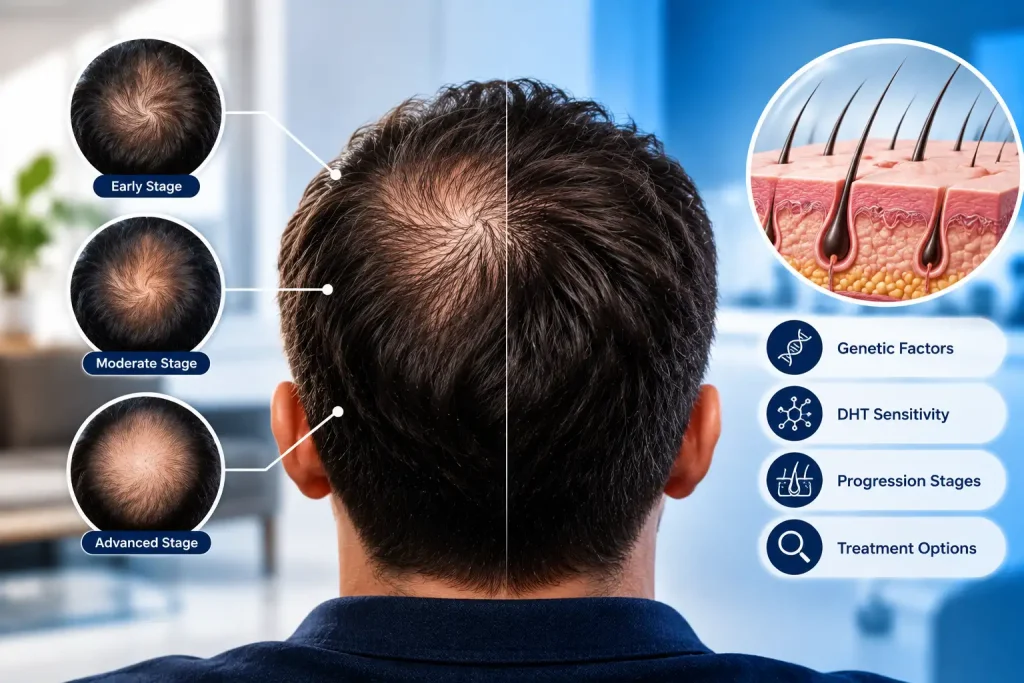
Donor hair is taken from a band across the back and sides of the scalp that’s relatively resistant to the DHT-driven miniaturisation responsible for pattern hair loss. This “safe donor area” varies in size between individuals — scalp size, hair density within that band, and how tightly that resistant zone is defined all differ in ways not visible without a hands-on assessment.
The International Society of Hair Restoration Surgery (ISHRS) guidance on donor hair harvesting explains that donor-site planning should be completed before harvesting begins and that the possibility of future hair loss should be considered when deciding how much donor hair to use.
It is therefore better to think of the donor area as a limited resource that needs to be managed over time rather than as an unlimited bank of grafts.
Density Isn’t the Same as Total Supply
Two people with visually similar donor areas can have genuinely different numbers of transplantable grafts, because density — follicular units packed per square centimetre — varies independently of how large the area looks. A smaller, denser donor zone can outperform a larger, sparser one, typically measured directly with a handheld densitometer rather than estimated from a photo.
Hair characteristics matter as well. Two patients can have a similar follicular-unit density but produce different cosmetic coverage because hair calibre, the number of hairs contained within each follicular unit and the distribution of those units can differ.
Research has also demonstrated that both hair density and hair diameter can have a substantial effect on the cosmetic outcome of hair transplantation. This is one reason why simply counting grafts without considering their characteristics can give an incomplete picture of donor capacity.
What Is the Difference Between Hair Count and Graft Count?
This distinction is important when comparing hair transplant plans.
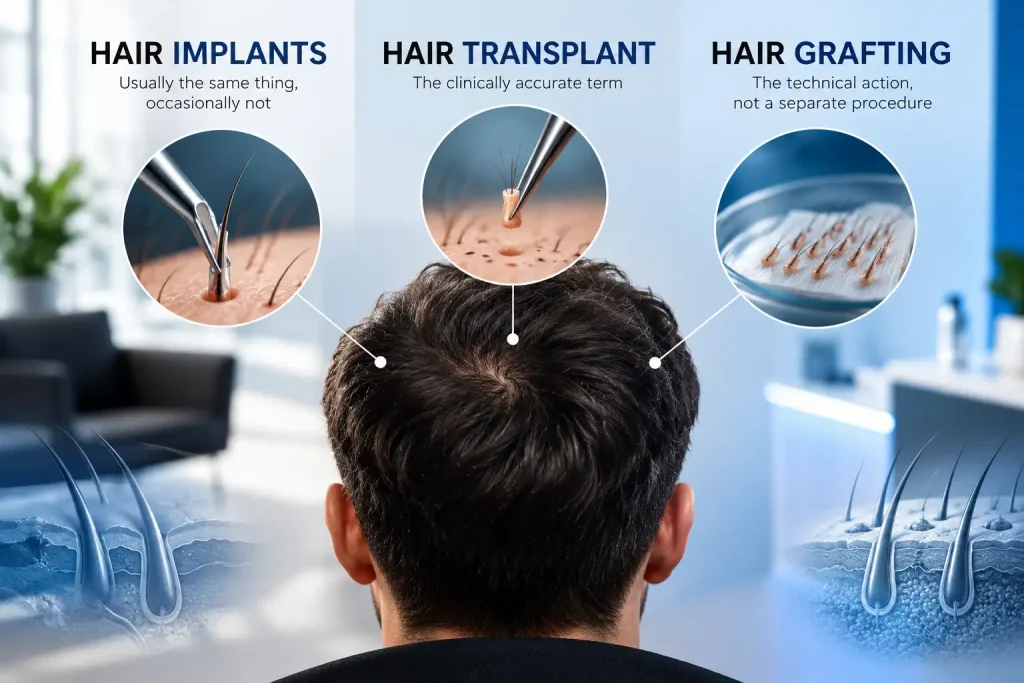
A follicular unit is a naturally occurring group of hair follicles. A graft refers to the follicular unit or prepared tissue that is moved during transplantation. One graft can therefore contain more than one hair.
As a result, “2,000 grafts” does not necessarily mean 2,000 individual hairs. The number of hairs contained within those grafts can vary from patient to patient.
When discussing donor supply, ask whether the clinic is quoting grafts, follicular units or individual hairs. Comparing different measurements as though they mean the same thing can make two treatment plans appear more similar than they actually are.
Why the Crown Draws Down Supply Faster
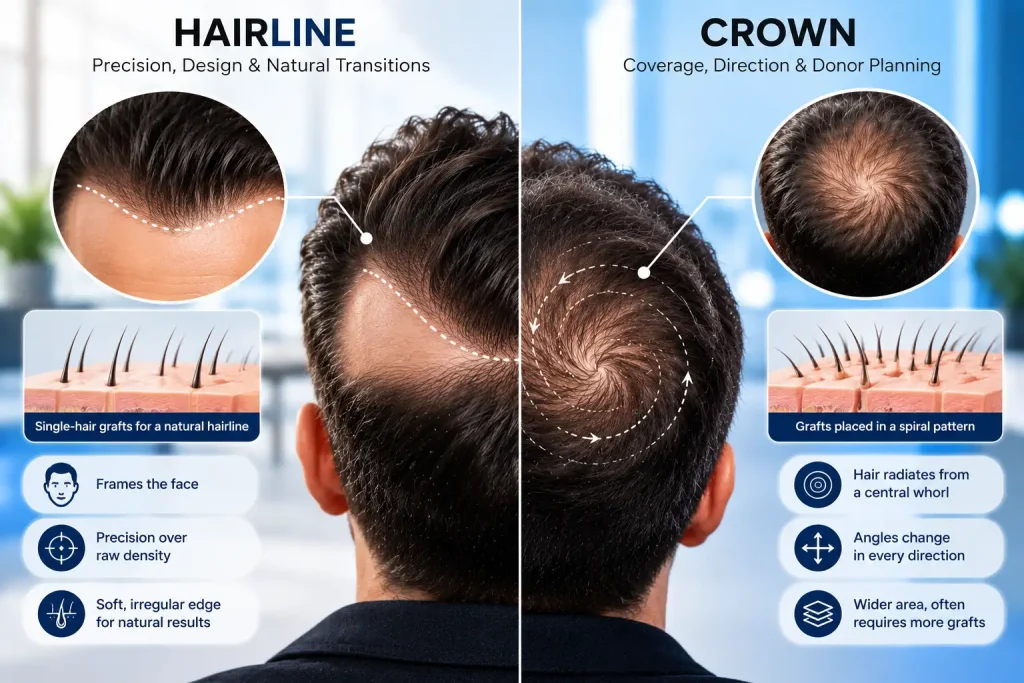
The crown radiates outward from a central whorl and covers considerably more surface area than a hairline zone. Achieving a visually convincing result there requires more grafts per unit of “noticeable improvement” than the same investment would achieve at the hairline — not because crown grafts are used less efficiently, but because there’s simply more ground to cover in every direction from the centre point.
This is particularly important when a patient wants both the hairline and crown treated. The available donor supply has to be allocated between areas rather than assuming that each area can independently receive the density it would ideally require.
For patients considering crown surgery, the City Clinics Crown Hair Transplant service provides clinic-specific information about how crown treatment is approached.
Why Surgeons Talk About “Budgeting” Donor Hair
Because pattern hair loss is progressive, today’s donor assessment isn’t just about what’s needed now — it’s about what might realistically be needed years from now if hair loss continues. A surgeon conserving donor supply now, even if it means a slightly less maximal result today, is making a considered trade-off in favour of future flexibility.
ISHRS guidance similarly highlights the importance of considering the possibility of future hair loss and reserving donor hair when appropriate. Donor harvesting should therefore be planned as part of the patient’s longer-term treatment strategy rather than treated as a one-time calculation.
What Is Overharvesting?
Overharvesting means removing too many follicular units from the donor region or distributing extraction too aggressively, potentially leaving the donor area visibly thin, patchy or otherwise compromised.
This matters particularly with FUE because individual follicular units are removed directly from the donor area. If extraction is too concentrated or excessive, the remaining donor hair may no longer provide the appearance or reserve that the patient expected.
The ISHRS guidance on revision and repair of previous hair transplants discusses overharvesting as a potential cause of thin or “moth-eaten” donor areas and highlights the importance of appropriate donor management.
Why Donor Extraction Needs to Be Distributed Carefully
Safe harvesting is not simply about deciding on a total number and removing that number from whichever area looks densest. The distribution of extraction matters because the remaining donor hair needs to maintain a natural appearance.
Harvesting too aggressively from a concentrated area can create visible thinning even if the total number of extracted grafts appears reasonable on paper. A well-planned extraction pattern therefore considers both the number of grafts required and how those grafts are distributed across the donor region.
ISHRS material on donor harvesting emphasizes that the donor area should be planned before harvesting begins, while professional guidance on FUE recognizes overharvesting as an important risk that needs to be managed during treatment planning.
What Happens If Donor Supply Is Genuinely Limited?
For patients with lower donor density relative to the area needing coverage, a single procedure covering everything at maximum density usually isn’t realistic. The honest alternatives are typically a staged approach prioritising the areas that matter most, combining surgery with non-surgical options such as scalp micropigmentation, or a frank conversation about what’s realistically achievable — all better conversations to have before a procedure than after one.
A limited donor supply does not necessarily mean that treatment is impossible. It means the treatment plan may need to be more selective about which areas are prioritised, what density is targeted and whether treatment should be staged over time.
The City Clinics FUE Hair Transplant page provides information about the clinic’s FUE approach and can be reviewed alongside an individual donor assessment.
Why This Can Only Be Assessed in Person
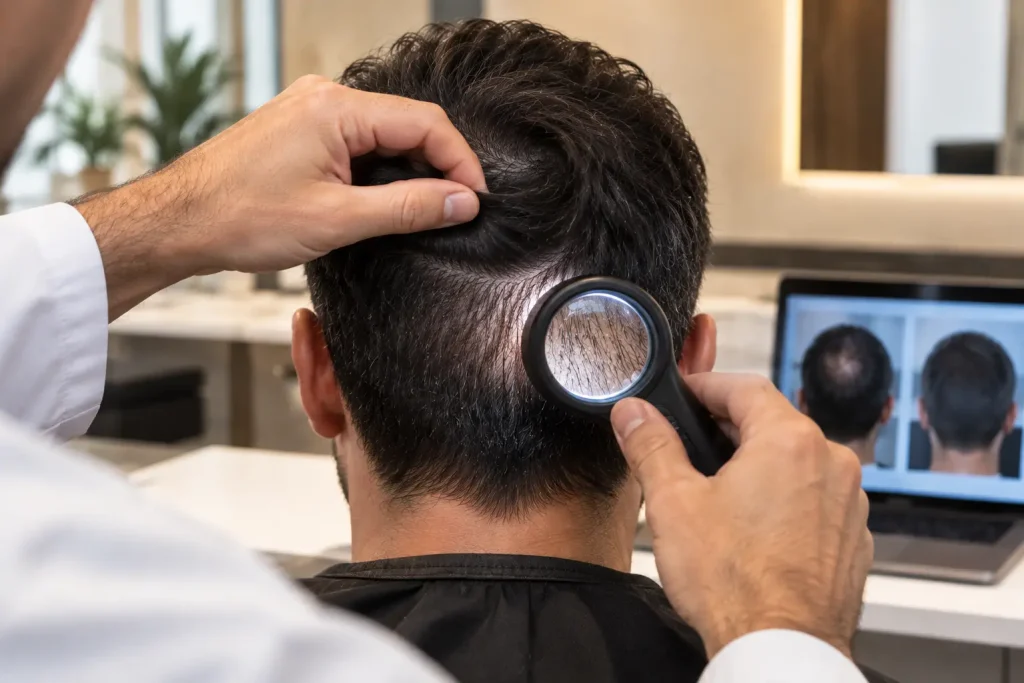
None of the factors above — safe donor area size, density, scalp laxity — can be reliably estimated from a photo or a self-reported Norwood stage, which is why a proper consultation always includes a hands-on donor assessment before any specific graft number is discussed.
A proper assessment may consider:
- Donor-area size and stability.
- Follicular-unit density.
- Number of hairs per follicular unit.
- Hair calibre and characteristics.
- Distribution of follicular units across the donor region.
- Previous FUE or FUT procedures.
- Current and anticipated future hair loss.
- The amount of donor supply that should be preserved for future needs.
Modern donor assessment can involve measured density and hair characteristics rather than relying only on visual inspection. Current hair-restoration technologies may also assist clinicians in evaluating donor characteristics, but the treatment decision still requires appropriate clinical assessment.
City Clinics’ Crown Hair Transplant page covers how this donor-budgeting consideration shapes the surgical plan specifically for crown cases.
Can Previous Hair Transplants Reduce Your Donor Supply?
Yes. Previous FUE or FUT surgery can affect the amount and quality of donor supply available for a future procedure.
With previous FUE, some follicular units have already been permanently removed. With previous FUT, the donor area may contain a linear surgical scar and the remaining donor characteristics need to be assessed before another procedure is planned.
This is why a patient considering a second or third transplant should not assume that the original graft count tells the whole story. The current donor area needs to be reassessed before additional harvesting is planned.
Can You Run Out of Donor Hair?
Yes. Donor supply is finite, which is why long-term planning matters.
Running out does not necessarily mean that every follicle in the donor region has literally been removed. It can also mean that further extraction would risk making the donor area visibly thin or compromising the remaining supply needed for future treatment.
The goal of donor management is therefore not simply to harvest as many grafts as possible. The goal is to use the available donor supply in a way that balances the current treatment objective with the patient’s future options.
Donor management is a lifetime planning problem
ISHRS FUE guidance specifically warns against overharvesting and notes that additional FUE is not recommended where harvesting would create visible donor thinning. Donor planning therefore has to account for possible future procedures, not just the current session.
The ISHRS FUE Clinical Practice Guidelines are a useful professional reference for understanding the principles involved in FUE donor harvesting and planning.
Current City Clinics KE-Bot planning describes donor capacity as a measured number that informs both graft requirement and pricing tier.
Patients should treat any technology-derived donor estimate as one part of a clinical assessment, rather than relying on it alone to determine how many grafts can safely be harvested.
What This Means for a Patient Comparing Clinics
The safest comparison is based on the complete treatment pathway rather than a single marketing label. Look at diagnosis, surgeon responsibility, donor planning, treatment design, realistic timelines, complication management and follow-up. Where a clinic makes a treatment-specific claim, keep it clearly attributed to the clinic rather than presenting it as a universal medical fact.
When comparing quotes, do not compare graft numbers alone. Ask how the clinic measured donor density, how many grafts are being proposed, where those grafts will be taken from, how much donor supply will remain and how future hair loss has been considered.
The number of grafts proposed should make sense in relation to the treatment area and the patient’s donor characteristics. A larger graft number is not automatically a better plan if it compromises donor appearance or future options.
Questions to Take to a Consultation
- Ask for measured donor density rather than a visual estimate.
- Ask how much donor capacity is being reserved for future loss.
- Ask whether previous transplant surgery has already used donor hair.
- Ask how extraction will be distributed across the donor area.
- Ask what happens if the requested coverage exceeds available supply.
- Ask whether the proposed graft number is based on measured donor characteristics.
- Ask who will perform the donor harvesting and surgical stages.
- Ask what the long-term plan would be if native hair loss continues.
Common Mistakes to Avoid
- Assuming the entire back and sides are permanently safe.
- Counting follicles without considering density and distribution.
- Using the donor area aggressively to reach a target number.
- Ignoring previous FUE or FUT surgery.
- Assuming a photograph can accurately determine donor capacity.
- Comparing clinics purely by the number of grafts offered.
- Assuming a higher graft count automatically means a better result.
- Ignoring the possibility of future hair loss.
Frequently Asked Questions
How much donor hair do I actually have?
There is no single safe donor number that applies to everyone. Your usable donor supply depends on the size and stability of the donor area, follicular-unit density, hair characteristics, previous surgery and how much supply needs to be preserved for future hair loss. A measured clinical donor assessment is required to estimate an appropriate graft plan.
What is the safe donor area?
It is the region judged suitable for harvesting based on the individual’s hair-loss pattern, stability and density. Its boundaries vary between people.
Can donor hair grow back after FUE?
The extracted follicle is removed, so that individual follicle does not regenerate. The surrounding hair can make the area look fuller as it heals.
Can you run out of donor hair?
Yes. Donor supply is finite, which is why long-term planning matters. Further harvesting may become inappropriate if it would create visible donor thinning or compromise future treatment options.
Does donor density affect price?
It can affect the graft plan, which in turn can affect the pricing tier where pricing is graft-banded.
Can donor hair be taken from the beard?
Specialist body- or beard-hair use exists in some hair-restoration contexts, but it is a different planning decision and should not be assumed suitable for every patient.
Can a photo tell me how many grafts I have?
Not reliably. A photograph can provide a general visual impression, but donor capacity depends on factors such as measured density, follicular-unit characteristics, donor-area stability and previous harvesting. A clinical assessment is needed before a specific graft number can be considered.
What is overharvesting in a hair transplant?
Overharvesting occurs when donor follicles are removed too aggressively or in excessive numbers, potentially causing visible thinning, patchiness or other donor-area problems. It can also reduce the supply available for future procedures.
Does a previous hair transplant reduce my donor supply?
Yes. Previous FUE permanently removes the follicular units that were harvested, while previous FUT surgery changes the donor area through strip removal and scarring. Any further surgery should therefore begin with a new donor assessment.
City Clinics Context
The clinic-specific details in this article should remain first-party claims and should be checked against the live service page immediately before publication. Current City Clinics pages describe surgeon-led care, one patient per surgeon per day, and a structured aftercare pathway. Those claims should not be generalized to other clinics.
The primary service discussed in relation to FUE donor harvesting is the City Clinics FUE Hair Transplant service.
For patients specifically considering treatment of the crown, the City Clinics Crown Hair Transplant service provides additional clinic-specific information.