In this article
The Crown Is a Distinct Zone in Pattern Hair LossWhy It’s Noticed Later Than Hairline LossThe Whorl Makes This Zone Genuinely More ComplexWhy It Tends to Consume More Donor HairThe Genetics Behind Crown-Specific LossA Practical Way to Actually Track ItProgression: What’s Worth Watching, and What Isn’tWhen Treatment Becomes Worth ConsideringSurgery Isn’t Always the First StepWhat this means for a patient comparing clinicsQuestions to take to a consultationCommon mistakes to avoidFrequently asked questionsCity Clinics contextCrown thinning is commonly part of androgenetic alopecia, but not every patch of crown loss has the same cause. A proper assessment distinguishes pattern loss from other forms of alopecia. If surgery is considered, the crown requires careful donor budgeting because the area is broad and the whorl makes direction and density difficult to reproduce.
Crown thinning is often noticed later, and taken less seriously at first, than a receding hairline — mostly because it’s genuinely harder to see on yourself. By the time it’s obvious in a photo taken from behind, it’s usually been developing for a while. Here’s what’s actually happening, and how to think about whether — and when — it’s worth treating.
The Crown Is a Distinct Zone in Pattern Hair Loss
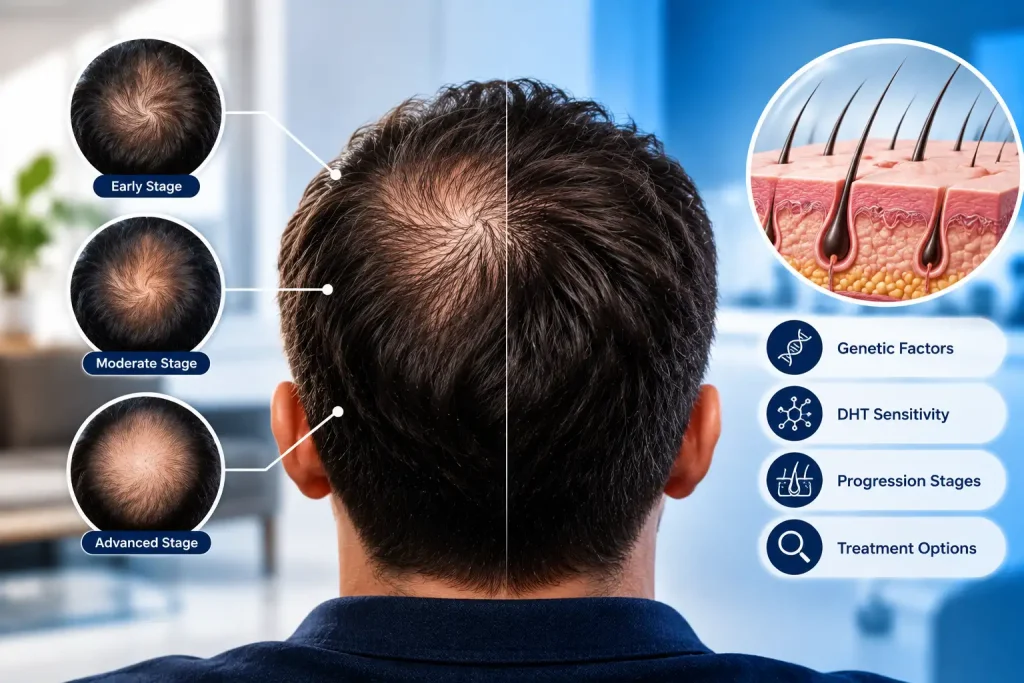
Crown, or vertex, thinning is part of the same androgenetic alopecia process that affects the hairline, but it doesn’t always progress at the same rate or start at the same time. On the Norwood scale, crown involvement typically becomes apparent from around stage 3-vertex onward, and it can appear before, alongside, or after hairline recession — there’s no fixed order.
Why It’s Noticed Later Than Hairline Loss
The simple, practical reason is visibility: a hairline is checked in the mirror daily, while the crown sits outside normal line of sight entirely. Crown thinning is most often first spotted in photographs taken from above or behind, or pointed out by someone else — meaning the person experiencing it frequently has less accurate information about how advanced it is than an outside observer.
The Whorl Makes This Zone Genuinely More Complex
Hair at the crown grows in a natural spiral pattern radiating from a central point — the whorl. This makes early thinning harder to disguise with styling, since there’s no single direction to comb hair across it, and it means any future surgical grafts need to follow that same radiating direction to look natural, a technically more demanding pattern to replicate than the more uniform growth at a hairline.
Why It Tends to Consume More Donor Hair
The crown covers a proportionally larger surface area than most people expect, and because the whorl radiates outward in every direction, achieving visual density across it typically requires more grafts than an equivalent-looking improvement at the hairline. A crown case and a hairline case with similar patient expectations are not equivalent in terms of donor hair required.
The Genetics Behind Crown-Specific Loss
Like all androgenetic alopecia, crown thinning is driven by follicle sensitivity to DHT, and that sensitivity is inherited rather than caused by anything lifestyle-related. The crown and hairline don’t necessarily share identical sensitivity — family history can point more strongly toward one pattern than the other, which is part of why two relatives can experience noticeably different hair loss patterns despite a shared genetic background.
A Practical Way to Actually Track It
A simple, consistent photo comparison — same angle, same lighting, same hair length, every few months — removes most of the guesswork memory alone can’t resolve, making real progression much easier to distinguish from normal day-to-day variation.
Progression: What’s Worth Watching, and What Isn’t
Early, minor, and apparently stable thinning can reasonably be monitored over several months before deciding on treatment. What’s worth taking more seriously is a clear, continuing trend — comparing consistent photographs is a genuinely useful, free way to establish whether change is real.
When Treatment Becomes Worth Considering
The honest answer depends on three things together: how much the thinning is actually progressing, how much it affects confidence day to day, and — given the donor-hair point above — whether there’s realistically enough donor supply to achieve a result worth the investment.
Surgery Isn’t Always the First Step
For early or slowly progressing crown thinning, non-surgical medical management may be considered where clinically appropriate, and in some cases this may be recommended before surgery is considered. The appropriate approach depends on the confirmed diagnosis, the pattern and rate of hair loss, and an individual’s medical circumstances.
City Clinics’ Crown Hair Transplant page covers the surgical approach and realistic timeline once treatment is being considered.
Why diagnosis comes before the crown quote
NHS guidance recommends understanding the cause of hair loss before approaching a commercial hair clinic. Crown thinning that is sudden, patchy, inflamed or otherwise atypical should not automatically be treated as androgenetic alopecia.
If pattern loss is confirmed, the crown still needs a long-term donor plan because the underlying process can continue around the transplant.
What this means for a patient comparing clinics
The safest comparison is based on the complete treatment pathway rather than a single marketing label. Look at diagnosis, surgeon responsibility, donor planning, treatment design, realistic timelines, complication management and follow-up. Where a clinic makes a treatment-specific claim, keep it clearly attributed to the clinic rather than presenting it as a universal medical fact.
Questions to take to a consultation
- Track crown change with consistent photos rather than memory.
- Confirm the diagnosis before considering surgery.
- Assess whether the pattern is still actively progressing.
- Ask how donor hair will be reserved for future loss.
- Ask what timeline is realistic for crown maturation.
Common mistakes to avoid
- Treating every crown thinning pattern as genetic baldness.
- Using a huge graft count to chase density without donor planning.
- Judging a crown result after only a few months.
- Ignoring ongoing native-hair loss.
Frequently asked questions
Why does crown hair loss happen?
The crown is commonly affected by androgenetic alopecia, but other causes exist and need assessment when the pattern is unusual.
Does crown hair loss mean I need a transplant?
No. Depending on diagnosis and progression, monitoring or non-surgical management may be appropriate before surgery. A qualified clinician should assess the underlying cause before a treatment decision is made.
Why is crown transplantation difficult?
Hair grows in a rotating whorl, so graft direction changes around the crown rather than following one straight line.
How long do crown results take?
City Clinics advises that crown results can mature over roughly 12–18 months.
Can the crown be treated with the hairline?
Sometimes, but the decision depends on graft requirement, donor supply and the priority of each area.
City Clinics context
The clinic-specific details in this article should remain first-party claims and should be checked against the live service page immediately before publication. Current City Clinics pages describe surgeon-led care, one patient per surgeon per day, and a structured aftercare pathway. Those claims should not be generalized to other clinics.
The City Clinics Crown Hair Transplant service is the primary service referenced in this article.