In this article
They’re Not Actually Two Different TechniquesThe Real Trade-OffsWhat About FUT?Recipient-Site Healing — a Less-Discussed DifferenceThe Time-Out-of-Body FactorWhat This Means for Session Length and SchedulingSo Which Is “Better”?What This Means for a Patient Comparing ClinicsQuestions to Take to a ConsultationCommon Mistakes to AvoidFrequently Asked QuestionsCity Clinics ContextSources and Further ReadingFUE describes a follicular-unit harvesting method; DHI is generally used for an implantation approach involving an implanter. They are therefore not two separate transplant categories. The surgeon, donor planning, graft handling, recipient-site design and aftercare matter more than the marketing label.
A lot of clinic marketing presents DHI as a separate, more advanced technology than FUE — something closer to a generational leap than a variation on an existing method. That’s not quite accurate, and the actual distinction matters more than the branding suggests, especially when it’s being used to justify a significant price difference between clinics offering what is, underneath the terminology, a closely related procedure.
They’re Not Actually Two Different Techniques
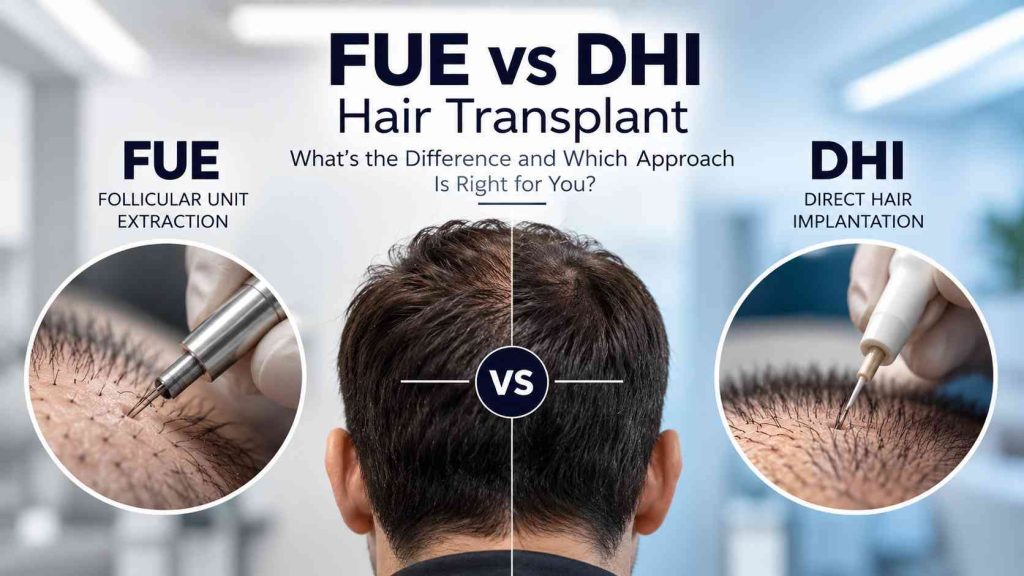
FUE (Follicular Unit Extraction) describes how grafts are removed from the donor area: individually, using a small circular punch tool, rather than removing an entire strip of scalp tissue the way the older FUT method does. DHI (Direct Hair Implantation) describes a specific way of placing grafts afterward — using a hollow, pen-shaped tool (often called a Choi implanter pen) that extracts and implants each graft in close succession, without pre-making separate recipient-site incisions first the way standard FUE implantation does.
In other words: DHI is used by some practitioners to describe an implantation approach; ISHRS states that DHI is not a separate hair-transplant method. When DHI is used after FUE harvesting, the harvesting stage remains FUE. When an implanter-based approach is used after FUE harvesting, the donor extraction is still performed using FUE. The two terms describe different stages of the overall procedure.
Marketing that presents DHI as a wholesale upgrade over FUE is describing one part of the overall process as though it replaced the whole thing, which is a meaningfully misleading simplification once someone understands what’s actually happening at each stage.
For patients considering this type of treatment, understanding the complete FUE hair transplant procedure can provide useful context for how donor extraction, graft handling and implantation fit together.
The Real Trade-Offs
Implantation control: the DHI pen can allow finer control over each individual graft’s angle and direction, which matters most in visually sensitive areas like the hairline.
Speed and volume: pre-made-incision FUE implantation is typically faster per graft, which can matter more for sessions targeting higher graft counts in a single sitting.
Learning curve: the DHI pen technique generally takes longer for a practitioner to master to a high standard than standard forceps-based implantation.
Surgeon skill matters more than the tool in either case: both methods produce excellent or disappointing results depending on who’s actually holding the instrument, not which instrument was chosen.
What About FUT?
Worth naming for context, since “FUE vs DHI” discussions often skip it entirely: FUT (Follicular Unit Transplantation), the older “strip” method, where a strip of scalp is surgically removed from the donor area and dissected under a microscope into individual grafts by a technical team.
FUT can yield a higher total graft count in a single session than FUE-based methods and is occasionally still used for very high graft-count cases where maximising numbers matters more than minimising donor-area scarring.
But it leaves a linear scar across the donor area — which can limit future hairstyle options, particularly very short haircuts — and involves a longer recovery at the donor site specifically.
This is the main reason FUE-based approaches, including DHI, have become the more commonly requested option for many patients today.
Recipient-Site Healing — a Less-Discussed Difference
Standard FUE implantation involves making small recipient-site incisions first, using a blade or fine needle, then placing grafts into them afterward, usually with forceps. DHI removes that separate step entirely, extracting and implanting through the same pen tool in close succession.
In theory this can mean slightly less total time each graft spends outside the body and marginally less cumulative trauma to the recipient area, since there’s no gap between site creation and graft placement.
In practice, though, final healing quality and how natural the result looks depend far more on the surgeon’s overall technique, planning, and graft-handling discipline than on which specific tool was used for this one step of the process.
The Time-Out-of-Body Factor
Every extracted graft is a small piece of living tissue, and graft survival rates decline the longer it sits outside the body before being replanted — this is one of the more consistently cited findings across hair restoration research.
This is also part of why implantation speed matters clinically, not just for scheduling convenience: a method that can replant a large graft count efficiently may matter more for bigger sessions than the marginal precision gains of a slower, more individualised technique would offer for a smaller one.
What This Means for Session Length and Scheduling
Procedures with very high graft counts sometimes run more efficiently with standard FUE implantation simply because more grafts can be placed per hour, which matters when a session is already stretching toward eight or more hours in a single day.
DHI’s more deliberate, one-graft-at-a-time approach can mean either a longer single session or a session split across two consecutive days for higher graft counts — a genuine scheduling factor worth knowing about in advance.
So Which Is “Better”?
Neither, universally. The right choice depends on total graft count, hair and scalp characteristics, and — more than either of those — the specific surgeon’s own experience and comfort level with each method.
That’s a conversation to have directly during a consultation, informed by an actual assessment, not a decision to make from a comparison chart or a clinic’s marketing page alone.
When comparing clinics, the technique name is only one part of the decision. Patients may also want to consider the hair transplant pricing and what is included in the overall treatment package.
City Clinics’ FUE hair transplant page sets out the clinic’s specific approach; the grafts-needed guide covers how graft count is estimated for a given case.
What the Terminology Means in 2026
FUE refers to the harvesting/excision of individual follicular units. ISHRS describes forceps and implanters as implantation methods and says DHI is not a separate hair-transplant method.
A clinic may use an implanter within an FUE workflow. The clinically useful comparison is therefore not ‘FUE versus DHI’ as two unrelated operations, but which harvesting and implantation approach is proposed and who performs the surgical steps.
What This Means for a Patient Comparing Clinics
The safest comparison is based on the complete treatment pathway rather than a single marketing label. Look at diagnosis, surgeon responsibility, donor planning, treatment design, realistic timelines, complication management and follow-up.
Where a clinic makes a treatment-specific claim, keep it clearly attributed to the clinic rather than presenting it as a universal medical fact.
The treatment journey also continues after the procedure, so understanding the hair transplant aftercare process is an important part of comparing the overall treatment pathway.
Questions to Take to a Consultation
- Ask who performs the extraction and implantation, not only who conducts the consultation.
- Ask how the donor area will be measured and how much donor reserve will remain.
- Ask why the proposed implantation approach fits your recipient area and graft count.
- Ask what happens if native hair loss continues after surgery.
- Compare the complete treatment and aftercare package, not the technique name alone.
Common Mistakes to Avoid
- Treating DHI as a superior replacement for FUE without understanding the terminology.
- Choosing a clinic because of a branded instrument name.
- Assuming an implanter automatically produces a natural-looking hairline.
- Ignoring donor depletion and future hair loss.
Frequently Asked Questions
Is DHI better than FUE?
Not inherently. DHI generally describes an implantation approach; FUE describes harvesting. The right technique depends on the case and the clinician’s execution.
Does FUE leave scars?
FUE avoids a linear strip scar but leaves small circular extraction marks. The appearance of these marks can vary depending on the procedure and individual healing.
Does DHI need fewer grafts?
No. Graft requirement is driven by the area, density goals, hair characteristics and donor supply, not by the name of the implantation tool.
How long does FUE take?
City Clinics describes a full surgical day, typically six to eight hours including breaks, although duration varies with the individual plan.
Can FUE stop future hair loss?
No. Transplantation restores areas using donor follicles but does not necessarily stop miniaturisation of untreated native hair.
City Clinics Context
The clinic-specific details in this article should remain first-party claims and should be checked against the live service page immediately before publication. Current City Clinics pages describe surgeon-led care, one patient per surgeon per day, and a structured aftercare pathway. Those claims should not be generalized to other clinics.
Patients researching what can realistically be achieved may also find it useful to review hair transplant results alongside the treatment approach, rather than evaluating a procedure name in isolation.
Sources and Further Reading
City Clinics — FUE Hair Transplant
ISHRS — A Guide to Hair Transplant Surgery
ISHRS — Why FUE Is So Confusing
NHS — Hair Transplant