In this article
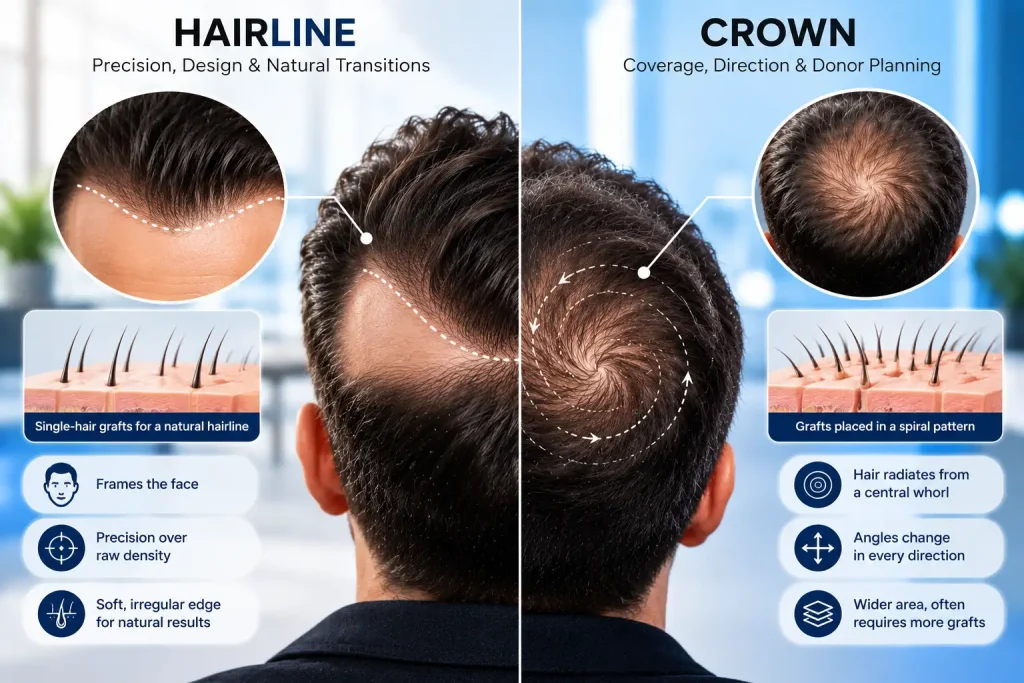
What This Means for CostCombining Both in One Session: A Donor-Budget ConversationWhy This Is a Conversation, Not a Fixed FormulaWhat this means for a patient comparing clinicsQuestions to take to a consultationCommon mistakes to avoidFrequently asked questionsCity Clinics contextHairline and crown restoration are not simply the same operation performed in different places. A hairline is a narrow, highly visible boundary where softness, age-appropriate design and single-hair grafts matter. A crown is a wider spiral where angles rotate around the whorl and grafts must be budgeted carefully across a larger area.
It’s a reasonable assumption that a hair transplant is a hair transplant — that the same number of grafts should produce a similar result wherever they’re placed. In practice, a hairline case and a crown case are planned around almost entirely different priorities, and understanding why explains a lot about why quotes, timelines, and surgeon recommendations can look so different between the two.
The Hairline: A Single Line That Defines the Whole Face
The hairline is a comparatively narrow zone, but it carries disproportionate visual weight — it frames the face and is the single most-scrutinised area in any before-and-after comparison. Planning here prioritises precision over raw density: the very front row is typically placed as fine, single-hair grafts to create a soft, irregular edge, since a hard, uniform line is one of the clearest tells of an unnatural result.
The Crown: A Wide, Radiating Zone With No Single Best Angle
The crown is a different problem entirely. It covers considerably more surface area, and because hair radiates outward from a central whorl in every direction, there’s no single consistent angle to plan around the way there is at a hairline. Every graft’s direction needs to be judged individually against where it sits in that spiral, a slower, more technically demanding placement process.
Density Strategy Differs Too
A hairline is typically planned with a density gradient — finer, sparser placement at the very front, building to fuller density further back. A crown is planned around a different priority: creating the visual illusion of coverage across a wide, radiating area, often working outward from the whorl’s centre in rings rather than gradient bands. These are genuinely different planning approaches, not the same technique applied to two locations.
Why Results Mature at Different Speeds
Because the crown starts from a wider, thinner base of coverage, initial results can look less immediately dramatic than a hairline case, even when the procedure has gone equally well. This is part of why crown cases are typically given a longer runway — up to 12 to 18 months — before a final result is properly judged.
What This Means for Cost
Because crown coverage typically requires more grafts for an equivalent visual improvement, and the placement is slower and more technically demanding, crown-inclusive cases are often priced higher than a hairline-only case with a similar graft count might suggest — reflecting a genuinely longer, more complex session, not a markup.
Combining Both in One Session: A Donor-Budget Conversation
Many patients need both zones addressed, and it’s often possible in a single session — but because crown coverage tends to consume donor hair faster than the hairline for a comparable visual improvement, combining both means real trade-off decisions about how the available donor supply is allocated.
Why This Is a Conversation, Not a Fixed Formula
Because the right balance depends entirely on an individual’s donor density and the pattern of loss in each zone, this genuinely isn’t something a generic online graft calculator can resolve — exactly why a proper consultation involves a hands-on donor assessment before any graft allocation is discussed.
City Clinics’ FUE Hair Transplant page and the Crown Hair Transplant page cover each zone’s specific approach in more detail.
How to compare crown and hairline results
Hairline photographs should show frontal and oblique views with comparable hair length and lighting. Crown cases should be photographed from above, because the vertex is otherwise difficult to judge.
City Clinics’ current results page publishes crown and hairline case files and states that patient-submitted photographs are shown as received when identified as such.
What this means for a patient comparing clinics
The safest comparison is based on the complete treatment pathway rather than a single marketing label. Look at diagnosis, surgeon responsibility, donor planning, treatment design, realistic timelines, complication management and follow-up. Where a clinic makes a treatment-specific claim, keep it clearly attributed to the clinic rather than presenting it as a universal medical fact.
Questions to take to a consultation
- Ask which zone should receive priority if donor supply is limited.
- Review comparable cases photographed from the correct angles.
- Ask how future hair loss affects both zones.
- Understand that crown density is visually different from hairline density.
- Ask whether treatment should be staged.
Common mistakes to avoid
- Using the same density target for the hairline and crown.
- Drawing a perfectly straight or overly low hairline.
- Assuming the crown can be filled without substantial donor use.
- Judging crown results too early.
Frequently asked questions
Which is harder to transplant, hairline or crown?
They have different technical challenges. Hairlines demand precise design and natural transitions; crowns require changing angles around a whorl and often cover a wider area.
Does the crown need more grafts?
Often it can require substantial graft numbers because the treatment area is broad, but the exact count varies.
Can hairline and crown be done together?
Sometimes. City Clinics says the decision depends on the graft budget and what the donor area can responsibly provide.
Why does the crown mature more slowly?
The visible result develops gradually and the whorl needs sufficient growth before coverage reads clearly.
Should the hairline always be treated first?
Not automatically. Priority depends on the pattern, progression, donor reserve and the patient’s goals.
City Clinics context
The clinic-specific details in this article should remain first-party claims and should be checked against the live service page immediately before publication. Current City Clinics pages describe surgeon-led care, one patient per surgeon per day, and a structured aftercare pathway. Those claims should not be generalized to other clinics.
The primary service discussed in this article is the City Clinics Crown Hair Transplant service.