In this article
Why Do Eyebrow Transplants Need a Different Technique?Why Single-Hair Grafts Matter in Eyebrow RestorationThe Importance of Hair Angle and DirectionWhere Does Donor Hair for an Eyebrow Transplant Come From?Why Transplanted Eyebrows Need Regular TrimmingWhat Does Clinical Research Tell Us About Eyebrow Transplants?What Should UK Patients Ask When Comparing Eyebrow Transplant Clinics?Recovery and Growth Expectations After an Eyebrow TransplantFrequently Asked Questions About Eyebrow Transplant TechniqueEyebrow Transplants at City Clinics, LondonSources and Further ReadingEyebrow transplants require a different approach from scalp hair transplants because eyebrow hairs are finer, lie at shallow angles and change direction across the brow.
For a natural-looking result, the surgeon must carefully consider graft selection, placement angle, hair direction, density and facial symmetry. Even small placement errors can be noticeable because the eyebrows are such a prominent feature of the face.Although both procedures use hair follicles transferred from a donor area, eyebrow restoration requires its own design and placement strategy. Understanding these differences can help UK patients ask more informed questions when comparing clinics and considering treatment.
Why Do Eyebrow Transplants Need a Different Technique?
The main difference is the way eyebrow hair naturally grows. Scalp hair generally provides coverage over a larger area, while eyebrows follow a compact, curved shape with distinct changes in direction. Each transplanted hair contributes to the overall outline and expression of the face.
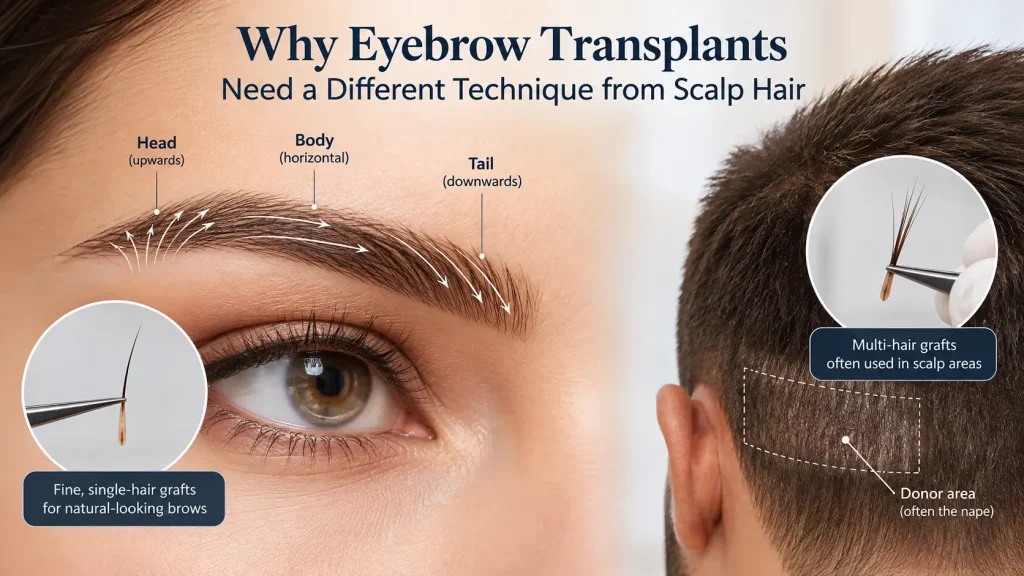
In scalp transplantation, surgeons commonly use different graft sizes to create a soft hairline and build density behind it. Eyebrow restoration places greater emphasis on fine individual hairs, shallow implantation angles and carefully controlled direction. The objective is not simply to add hair; it is to recreate the natural flow of an eyebrow.
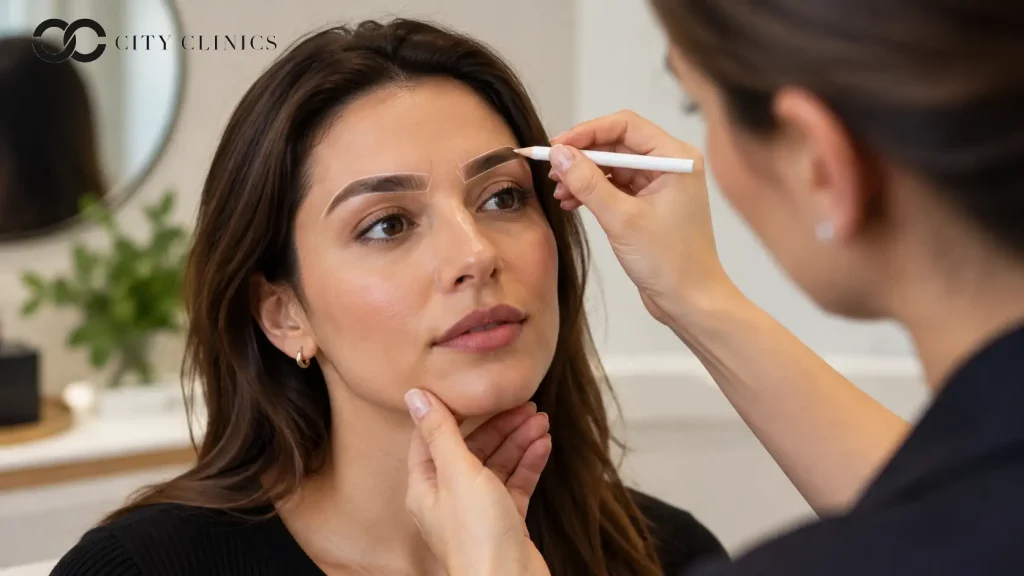
This requires detailed planning before implantation begins. The surgeon needs to consider the patient’s existing brow shape, facial proportions, skin characteristics, donor hair and the pattern of hair loss. The treatment plan should also account for differences between the two eyebrows rather than assuming that perfect visual symmetry is always natural.
The City Clinics eyebrow transplant service page explains its approach to brow design, fine single-hair graft selection and placement.
Why Single-Hair Grafts Matter in Eyebrow Restoration
Hair follicles naturally grow in small groupings called follicular units. Depending on the donor area, these units may contain one or several hairs. Scalp hair transplantation can use a combination of single-, double- and multiple-hair grafts, depending on the area being treated and the desired result.
Eyebrow transplantation usually places particular emphasis on single-hair grafts because individual hairs allow the surgeon to control the direction, spacing and visual softness of the reconstructed brow. A multi-hair graft in an inappropriate position can create a thicker or more clustered appearance than the surrounding eyebrow.
Single-hair graft selection is therefore an important consideration when discussing eyebrow hair transplant technique. However, patients should ask the surgeon to explain the graft-selection strategy for their individual case rather than assuming that graft count alone determines quality.
A 2018 systematic review of eyebrow and eyelash transplantation examined 67 articles involving 354 patients. It identified follicular unit transplantation as the most commonly reported approach, while noting that technique selection depends on the patient’s presentation and the surgeon’s approach.
Read the systematic review on PubMed.
The Importance of Hair Angle and Direction
One of the most technically demanding aspects of eyebrow transplantation is reproducing the natural direction of eyebrow hair. Unlike a scalp area, where hair direction may be more consistent across a particular region, eyebrow hairs follow a changing pattern along a short, curved surface.
The head of the eyebrow
Near the nose, eyebrow hairs often point upwards or slightly outwards. This creates the softer, feathered appearance associated with the inner brow. If transplanted hairs are placed at an unsuitable angle, they may stand out from the surrounding hairs.
The body of the eyebrow
Through the central section, hairs generally follow a more outward direction. The precise pattern varies between individuals, so the surgeon should assess the existing eyebrow and design the placement accordingly.
The tail of the eyebrow
Towards the outer end, hairs commonly sweep outward and may angle downwards. This helps define the eyebrow’s taper. Reproducing the transition between the body and tail is important for avoiding an abrupt or unnatural-looking outline.
Eyebrow hairs are generally implanted at a shallow angle to the skin. The exact angle and direction depend on the position being restored, the patient’s anatomy and the existing hair pattern. There is no single angle that suits every part of every eyebrow.
A clinical case series involving 352 patients highlighted the importance of anatomical knowledge, experience and technical skill in eyebrow restoration using single-follicular-unit transplantation.
Read the clinical case series on PubMed.
Where Does Donor Hair for an Eyebrow Transplant Come From?
Eyebrow transplants generally use hair follicles taken from a suitable donor area, commonly on the scalp. The selected donor hair needs to be assessed for its thickness, texture, curl, colour and other characteristics that may affect how it looks after transplantation.
Fine hair can be useful when reconstructing delicate eyebrow detail. In some cases, hair from the nape of the neck or another suitable scalp area may be considered because its characteristics may be closer to the patient’s existing eyebrow hair. The most appropriate donor area depends on individual anatomy and the availability and quality of suitable follicles.
City Clinics states that its eyebrow transplant approach involves selecting fine single-hair grafts from the nape area. This is a description of the clinic’s own stated technique, not a universal rule for every eyebrow transplant.
Learn more about the City Clinics eyebrow transplant procedure.
During consultation, patients should ask why a particular donor area has been recommended, how the surgeon plans to select suitable follicles and whether the donor area can safely support the proposed treatment.
Why Transplanted Eyebrows Need Regular Trimming
An important difference between natural eyebrow hair and transplanted scalp hair is the growth behaviour of the follicles. Hair retains many of the characteristics associated with its original donor area after transplantation. As a result, transplanted scalp hairs in the eyebrows may continue growing longer than the surrounding natural eyebrow hairs.
Regular trimming may therefore be necessary to maintain the intended eyebrow shape. How often trimming is needed varies according to the individual’s hair growth, the characteristics of the donor hair and the desired appearance.
This ongoing maintenance should be discussed before treatment. An eyebrow transplant can restore hair to an area with sparse growth, but it does not make transplanted scalp hair behave exactly like natural eyebrow hair.
Patients should follow their clinic’s instructions about when trimming can safely begin after surgery. The recipient area needs time to heal, and early aftercare instructions should take priority over routine grooming.
What Does Clinical Research Tell Us About Eyebrow Transplants?
Published research supports the importance of careful planning and appropriate technique in eyebrow restoration. However, the evidence base includes a range of surgical methods, patient groups and causes of eyebrow loss. Findings from one study should not automatically be applied to every patient or every clinic.
Systematic review of eyebrow and eyelash transplantation
A systematic review published in 2018 assessed 67 articles covering 354 patients from 18 countries. Follicular unit transplantation was the most commonly reported approach, although other reconstruction methods were also described. The authors noted that technique selection depends on the patient’s presentation and the surgeon’s approach.
This review provides useful context for understanding why eyebrow restoration requires individualised planning. It does not establish one universally superior method for every patient.
View the review on PubMed.
Clinical case series involving 352 patients
A published case series evaluated eyebrow restoration in 352 patients using single-follicular-unit transplantation. The researchers reported that outcomes depended substantially on anatomical knowledge, experience and technical skill. The study offers clinical insight into the importance of placement and direction, although results from a case series cannot ensure the same outcome for another individual.
Read the 352-patient clinical case series.
Research on unsatisfactory eyebrow transplant results
A 2024 retrospective study examined 100 patients who were dissatisfied with previous eyebrow transplantation. The researchers identified concerns including sparse growth, uneven density, disordered hair direction and hair characteristics that did not match the surrounding eyebrow. Because the study focused on patients presenting with unsatisfactory results, its findings should not be interpreted as complication rates for all eyebrow transplants.
The findings nevertheless reinforce the importance of discussing hair direction, graft selection, realistic expectations and communication with the surgeon before treatment.
Read the 2024 study on unsatisfactory eyebrow transplant results.
Taken together, this literature supports a practical conclusion: eyebrow restoration requires attention to anatomy, individual hair characteristics and the direction of each implanted follicle. The available evidence does not remove the need for an individual assessment or allow a clinic to promise a particular cosmetic result.
What Should UK Patients Ask When Comparing Eyebrow Transplant Clinics?
When comparing eyebrow transplant clinics in the UK, patients should look beyond the advertised technique or the number of grafts offered. A suitable assessment should cover the cause of eyebrow loss, the proposed design, donor suitability, the surgeon’s role, possible risks and the aftercare required.
Consider asking the following questions during a consultation:
- Graft selection: How will the surgeon select suitable fine hairs and determine which grafts are appropriate for each part of the eyebrow?
- Placement angle: How will the angle and direction of the implanted hairs be planned across the head, body and tail?
- Design and symmetry: How will the proposed shape be assessed against my facial proportions and existing eyebrow pattern?
- Donor area: Which area is being considered, and why is it suitable for my hair characteristics?
- Surgeon responsibility: Who will assess my suitability, plan the procedure, perform the surgical steps and oversee my care?
- Risks and limitations: What complications or cosmetic limitations could apply in my circumstances?
- Previous procedures or scarring: How might scar tissue or earlier treatment affect the plan and expected outcome?
- Aftercare: What follow-up is included, and what should I do if healing or hair growth does not progress as expected?
- Long-term maintenance: How frequently might I need to trim the transplanted hairs?
- Evidence of results: Can the clinic show appropriately documented examples of cases similar to mine, with meaningful time points and clear consent for the use of photographs?
If you are comparing results, review photographs carefully. Lighting, camera angle, eyebrow grooming and the time elapsed since treatment can all affect how images appear. Ask the clinic to explain the context of any examples rather than relying on photographs alone.
You can explore the clinic’s published information on the
City Clinics results page.
The clinic states that comparable eyebrow cases may be discussed privately during consultation. Availability of specific examples should be confirmed directly with the clinic.
Patients may also find it useful to review the clinic’s
aftercare information
and ask what support is provided throughout recovery.
Recovery and Growth Expectations After an Eyebrow Transplant
Recovery varies according to the individual, the treatment performed and the condition of the recipient area. Patients should receive personalised instructions covering cleaning, activity, protecting the grafts and recognising symptoms that require clinical advice.
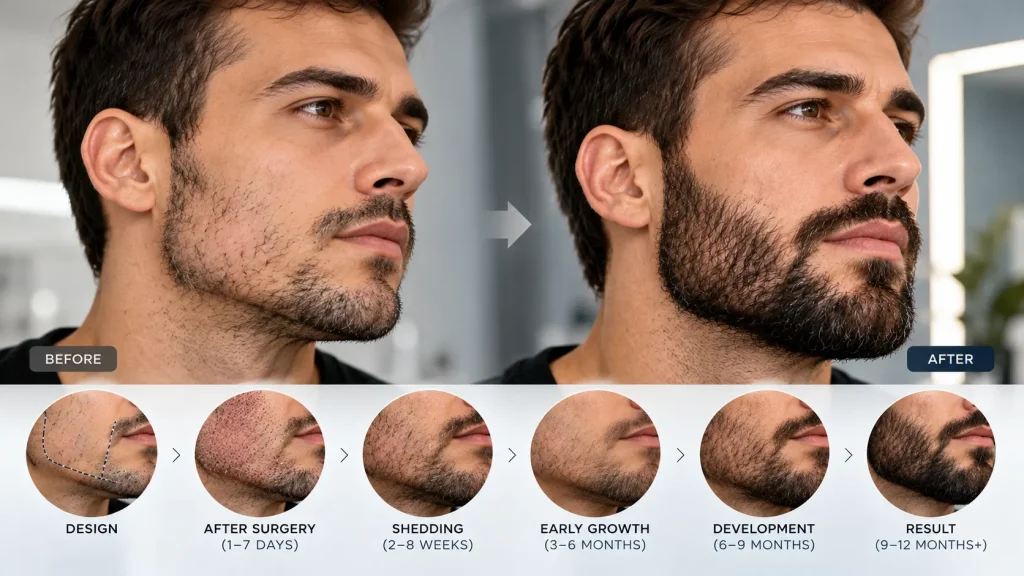
Small scabs and temporary changes in the appearance of the transplanted hairs may occur during early healing. Some transplanted hairs may shed before new growth becomes visible. The timing and extent of growth vary, so patients should not judge the final cosmetic result too early.
City Clinics’ published eyebrow transplant information describes growth becoming established over approximately three to six months, with further refinement towards twelve months. These are the clinic’s general guidance points rather than a fixed timeline for every patient.
The final appearance depends on factors such as graft survival, hair characteristics, placement, healing and the individual’s circumstances. Transplanted follicles can continue to grow over the long term, but growth, survival and cosmetic appearance vary between individuals. No specific outcome should be promised.
If you experience increasing pain, spreading redness, worsening swelling, discharge, fever or another concerning symptom after surgery, contact your treating clinic promptly or seek appropriate medical advice.
Frequently Asked Questions About Eyebrow Transplant Technique
Why are eyebrow transplants different from scalp hair transplants?
Eyebrows cover a smaller area, and their hairs usually grow at shallow angles with changing directions across the brow. The surgeon must pay close attention to individual hair placement, graft selection, density and the natural eyebrow shape.
Why are single-hair grafts important for eyebrow restoration?
Single-hair grafts allow precise control over the spacing and direction of individual hairs. They are commonly used to create a softer, more natural-looking eyebrow, although the appropriate graft strategy depends on the treatment plan and the patient’s anatomy.
At what angle are eyebrow transplant hairs placed?
Eyebrow hairs are generally placed at a shallow angle to the skin. The angle and direction vary across the eyebrow, so placement should follow the individual’s natural hair pattern rather than a single fixed angle.
Where does eyebrow transplant hair come from?
Donor hair is commonly taken from a suitable area of the scalp. The surgeon assesses the hair’s thickness, texture and other characteristics before deciding which donor area is appropriate. City Clinics states that it selects fine single-hair grafts from the nape area for its eyebrow transplant approach.
Will transplanted eyebrow hair need trimming?
Often, yes. Transplanted scalp hair may retain its longer growth behaviour after being moved to the eyebrow. Regular trimming may be needed to maintain the intended shape, although the frequency varies between individuals.
Is an eyebrow transplant the same as microblading?
No. An eyebrow transplant transfers hair follicles that can produce growing hairs. Microblading uses pigment to create the appearance of eyebrow hairs on the skin. The procedures differ in technique, maintenance, limitations and the results they can produce.
Can an eyebrow transplant restore hair in a scarred area?
It may be possible in selected cases, but suitability depends on the cause and characteristics of the scar, the condition of the recipient skin, donor availability and other clinical factors. A qualified clinician should assess the area and explain the limitations before treatment is considered.
How long does it take to see eyebrow transplant results?
Growth develops over time, and early shedding may occur. City Clinics describes growth becoming established over approximately three to six months, with further refinement towards twelve months. Individual timelines and cosmetic outcomes vary.
How can I compare eyebrow transplant clinics in the UK?
Ask about the clinician’s experience, graft-selection method, placement technique, donor planning, risks, aftercare and the evidence supporting the clinic’s claims. Review documented results carefully and make sure you understand the proposed plan before deciding.
Eyebrow Transplants at City Clinics, London
City Clinics provides eyebrow transplant treatment at its Harley Street clinic in London. Its published approach describes careful eyebrow design, selection of fine single-hair grafts from the nape area and placement at shallow angles to follow the natural direction of brow hair.
These are descriptions of the clinic’s own stated service. Whether the approach is suitable for a particular patient depends on individual assessment, including the cause of eyebrow loss, the condition of the recipient area and the availability of appropriate donor hair.
If you are considering treatment, read the
City Clinics eyebrow transplant information
and discuss your goals, likely maintenance needs, risks and realistic expectations with a qualified clinician.
Clinic address: 82 Harley Street, London W1G 7HN
Telephone: 020 7018 9060
Sources and Further Reading
- Klingbeil KD, Fertig R. Eyebrow and Eyelash Hair Transplantation: A Systematic Review.
PubMed. - Clinical outcomes and technical tips for eyebrow restoration using single-follicular-unit hair transplantation: A case series review.
PubMed. - Eyebrow reconstruction: options for reconstruction of cutaneous defects of the eyebrow.
PubMed. - Clinic Analysis and Effective Improvement Tips for Poor Eyebrow Transplantation.
PubMed. - City Clinics. Eyebrow Transplant London.
Official clinic service page.
Medical disclaimer:
This article is intended for general educational purposes and does not replace an individual medical assessment, diagnosis or treatment plan. The suitability of eyebrow transplantation and the likely outcome should be discussed with a qualified clinician after an appropriate assessment.