In this article
Eyebrow Transplant Recovery Timeline: What to ExpectWhat Happens During the First Few Days After an Eyebrow Transplant?Swelling, Redness and Scabbing After Eyebrow Transplant SurgeryEyebrow Transplant Shedding: Why Do Transplanted Hairs Fall Out?When Does New Eyebrow Growth Begin After a Transplant?Eyebrow Transplant Aftercare: How to Protect the GraftsLong-Term Eyebrow Transplant Care: Trimming and GroomingWhen Should You Contact Your Clinic After an Eyebrow Transplant?Choosing an Eyebrow Transplant Clinic in the UKFrequently Asked Questions About Eyebrow Transplant RecoveryEyebrow Transplant Recovery at City ClinicsSources and Further ReadingEyebrow transplant recovery takes place over several stages, from initial healing and scab formation to temporary hair shedding and gradual regrowth.
Mild redness, swelling and small scabs may occur during the early recovery period. Transplanted hairs can shed before new growth develops over the following months, with further changes in appearance continuing towards the one-year mark.Because the eyebrows are directly on the face, early recovery may be more noticeable than recovery from a scalp procedure. Understanding the healing process, following the clinic’s aftercare instructions and knowing when to seek medical advice can help patients prepare for treatment.This guide explains the typical stages of eyebrow transplant recovery, what shedding means, how to care for the treated area and what UK patients should discuss with their treating clinician.
Eyebrow Transplant Recovery Timeline: What to Expect
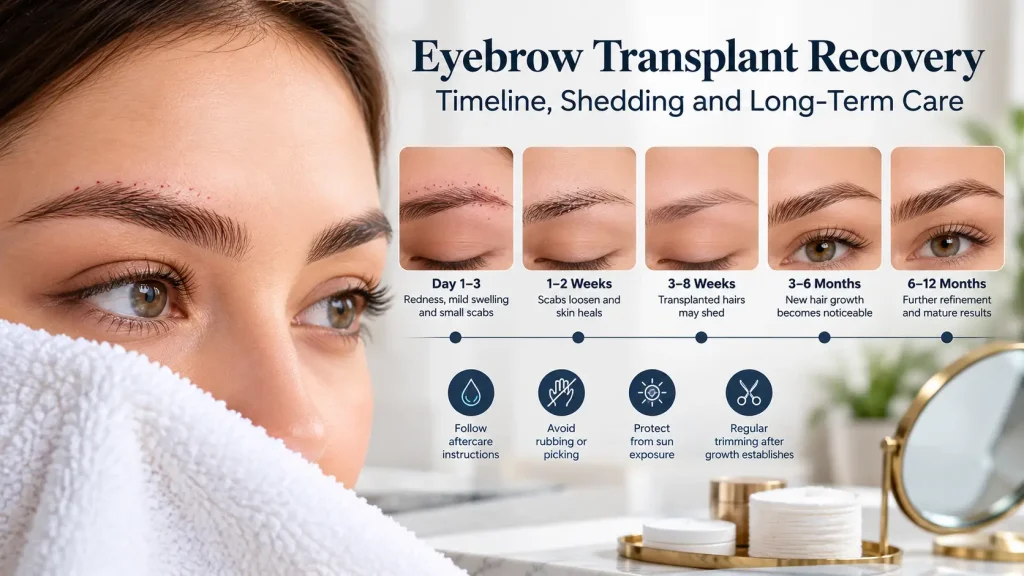
Eyebrow transplant recovery is best understood as a series of stages rather than a single healing date. The skin may recover relatively quickly, but visible hair growth takes longer. The exact timeline varies according to the individual, the procedure performed, the condition of the recipient area and the clinic’s aftercare protocol.
The following table is a general guide, not a fixed schedule. Your treating clinician’s instructions should take priority.
| Recovery stage | What may happen | What to keep in mind |
|---|---|---|
| First few days | Redness, mild swelling, tenderness and small scabs may develop around the treated area. | Protect the grafts and follow the clinic’s cleaning and activity instructions. |
| First one to two weeks | Scabs gradually loosen and the skin continues to heal. Some visible redness may remain. | Do not pick scabs or rub the treated area. Healing times vary. |
| First several weeks | Transplanted hairs may shed as the follicles move through their growth cycle. | Shedding does not automatically mean that the transplant has failed. |
| Approximately three to six months | New hair growth may become increasingly noticeable. | Growth may be uneven initially, and individual results differ. |
| Approximately six to twelve months | The appearance may continue to develop as the transplanted hairs grow and mature. | Assess progress over time rather than judging the result during early recovery. |
City Clinics describes meaningful eyebrow hair growth developing over approximately three to six months, with further refinement towards twelve months. These are general time frames stated by the clinic, not a promise of when an individual patient will see results.
For procedure-specific information, visit the City Clinics eyebrow transplant service page
and discuss your expected recovery with the treating clinician.
What Happens During the First Few Days After an Eyebrow Transplant?
The first few days focus on protecting the transplanted follicles while the recipient skin begins to heal. The treated area may look red, feel tender or develop small scabs around the implanted hairs. Some patients may also experience swelling around the eyelids or under-eye area.
Because the eyebrows are prominent facial features, these changes can be more noticeable than similar signs of healing beneath scalp hair. Patients should consider the practical implications when planning work, social events or other commitments.
The clinic should provide written instructions explaining how to protect the grafts, when and how to clean the area, which activities to avoid and when follow-up is required. Instructions may differ according to the surgical technique and the patient’s circumstances.
Can you return to work after an eyebrow transplant?
The appropriate time to return to work depends on the procedure, your recovery and the demands of your job. Desk-based work may present different practical considerations from work involving strenuous activity, dust, heat or a risk of contact with the treated area.
There is no single return-to-work date that is suitable for everyone. Ask your clinic for advice based on your procedure and recovery plan, and allow additional flexibility if visible redness or scabbing would be a concern.
Swelling, Redness and Scabbing After Eyebrow Transplant Surgery
Mild swelling, redness and small scabs can occur after eyebrow transplantation. These are possible features of early healing, but their severity and duration vary between patients.
Swelling around the eyes
The eyebrow area is close to the eyelids, so swelling may affect the surrounding skin. It can be more noticeable during the first few days after treatment. However, significant, worsening or unexpected swelling should not automatically be assumed to be normal.
Follow the clinic’s advice about managing swelling. Do not apply ice, creams or other products directly to the grafts unless your treating team has specifically instructed you to do so.
Redness and scabs
Redness and small scabs may appear around the implanted hairs as the skin heals. Scabs should be allowed to loosen according to the aftercare instructions rather than being pulled or picked off.
Picking at scabs, rubbing the eyebrow or applying unapproved products may interfere with healing and potentially damage the grafts. If the skin becomes increasingly painful, hot, red or swollen, contact the treating clinic for advice.
For general information about hair transplant recovery and risks, see the NHS guide to hair transplant surgery.
It provides broader guidance on hair transplantation; your own clinic should advise you about eyebrow-specific aftercare.
Eyebrow Transplant Shedding: Why Do Transplanted Hairs Fall Out?
Transplanted eyebrow hairs may shed during the weeks following treatment. This can be worrying because the eyebrows may temporarily appear sparse again, but shedding of the visible hair does not necessarily mean that the transplanted follicle has been lost.
After transplantation, a hair follicle can enter a resting phase before producing a new hair. The timing and extent of shedding vary between individuals, and not every patient follows exactly the same pattern.
Does shedding mean the eyebrow transplant has failed?
No. Shedding alone does not establish that a transplant has failed. The visible hair shaft can fall out while the follicle remains in place. New growth may develop later, although the amount of growth and final appearance cannot be predicted with certainty.
Patients should avoid judging the result based only on the appearance of the eyebrows during the shedding phase. If you are concerned about unusually extensive hair loss, damaged grafts or the condition of your skin, contact your treating clinic rather than attempting to assess graft survival yourself.
How is shedding different from graft damage?
Shedding of the hair shaft is part of the possible post-transplant growth cycle. Graft damage, infection or other complications are different concerns that cannot reliably be diagnosed from appearance alone.
Follow the aftercare instructions carefully and seek advice if you experience unexpected bleeding, increasing pain, discharge or another concerning change.
When Does New Eyebrow Growth Begin After a Transplant?
New growth may become visible over the months following an eyebrow transplant. Some patients notice changes earlier than others, and initial growth may be uneven. The eyebrows may not look fully developed simply because a few hairs have started to appear.
City Clinics describes meaningful growth over approximately three to six months, with further refinement towards twelve months. Individual growth patterns and timelines may vary.
The final appearance depends on multiple factors, including donor hair characteristics, graft survival, placement direction, healing and the patient’s individual circumstances. Transplanted follicles can continue to grow over the long term, but growth, survival and cosmetic appearance vary between individuals.
Why should you avoid judging the result too early?
Early shedding and gradual regrowth can make the eyebrows look different from one month to the next. Assessing the final appearance too soon may lead to unnecessary concern or unrealistic comparisons with photographs taken at a later stage.
If you want to track progress, take photographs at consistent intervals using similar lighting, angles and facial expressions. Discuss your progress during scheduled follow-up appointments and ask the clinic when a meaningful assessment of the result would be appropriate.
You can also review the City Clinics results page
for examples of the clinic’s published treatment results. Before-and-after photographs should be considered in context, including the time elapsed after treatment and the circumstances of the individual case.
Eyebrow Transplant Aftercare: How to Protect the Grafts
Appropriate aftercare helps protect the treated area while it heals. Because the eyebrows are exposed to everyday contact, facial cleansing and grooming, patients should understand exactly how to care for the grafts during the early recovery period.
Your surgeon’s written instructions should take priority over generic advice, including the guidance below.
1. Follow the clinic’s washing instructions
Ask when washing can resume, which products are suitable and how the treated area should be cleaned. Avoid rubbing, scrubbing or directing forceful water pressure at the grafts unless your clinic has advised that it is safe.
2. Avoid picking or rubbing the eyebrows
Do not pull at scabs, scratch the recipient area or repeatedly touch the grafts. If itching or discomfort becomes difficult to manage, contact the clinic for advice rather than applying an unapproved product.
3. Ask about exercise and activities
Strenuous exercise and activities that cause heavy sweating may need to be restricted for a period after treatment. The appropriate duration depends on the procedure and your clinician’s instructions. Ask specifically about exercise, swimming and activities that could expose the grafts to friction or contamination.
4. Protect the treated area
Follow the clinic’s guidance on sun exposure, hats, skincare, makeup and other products around the eyebrows. Avoid applying cosmetics or skincare products to the recipient area until your treating team confirms that it is appropriate.
5. Attend follow-up appointments
Follow-up allows the clinic to assess healing, answer questions and advise you about the next stage of recovery. If you are unsure whether a change is expected, ask the treating team rather than relying solely on online photographs or general timelines.
Read the City Clinics aftercare information
and confirm the instructions that apply specifically to your eyebrow transplant.
Long-Term Eyebrow Transplant Care: Trimming and Grooming
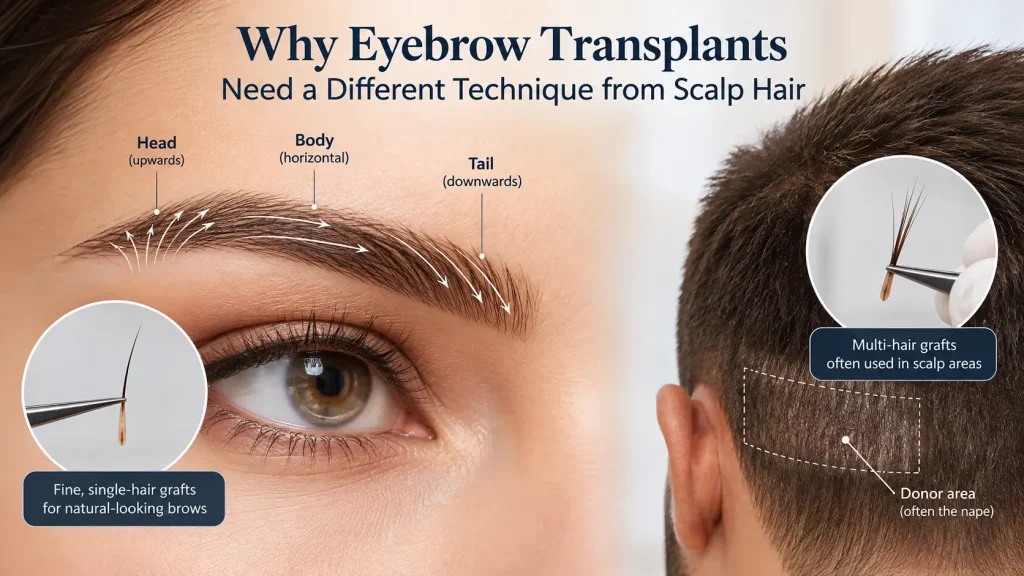
Recovery does not end when new hairs appear. Transplanted scalp hair can retain characteristics of its original donor area, including a tendency to grow longer than natural eyebrow hair. Regular trimming may therefore become part of long-term eyebrow maintenance.
The frequency of trimming varies according to the growth rate, texture and length of the transplanted hair, as well as the shape you want to maintain.
Do not begin trimming or grooming the treated area until the clinic confirms that it is safe. Once healing is complete, ask the clinician how to maintain the eyebrow without damaging the skin or compromising the intended shape.
This ongoing commitment is worth considering before treatment. An eyebrow transplant may restore hair to sparse areas, but it does not make transplanted scalp hair behave exactly like natural eyebrow hair.
For more detail on why donor hair, placement angle and growth characteristics matter, read our related guide: Why Eyebrow Transplants Need a Different Technique from Scalp Hair.
When Should You Contact Your Clinic After an Eyebrow Transplant?
Some redness, swelling and scabbing may occur during early healing, but symptoms that are severe, worsening or unexpected need appropriate clinical assessment.
Contact your treating clinic promptly if you experience:
- Increasing or severe pain rather than gradual improvement.
- Spreading redness, increasing warmth or worsening swelling.
- Unexpected or persistent bleeding.
- Discharge or pus from the treated area.
- Fever or feeling generally unwell alongside local symptoms.
- Concerns that the grafts have been disturbed or damaged.
If you develop severe eye pain, changes in vision or another urgent eye-related symptom, seek urgent medical assessment rather than waiting for a routine clinic appointment.
Do not attempt to diagnose an infection or another complication from photographs alone. Your treating clinician can assess your symptoms and advise on the appropriate next step.
Choosing an Eyebrow Transplant Clinic in the UK
Recovery and aftercare should be considered when comparing eyebrow transplant providers. The decision should not be based only on price, the number of grafts offered or photographs of previous results.
Consider asking each clinic the following questions:
- Who will assess my suitability and explain the risks?
- Who will design and perform the procedure, and what are their qualifications?
- What written aftercare instructions will I receive?
- How can I contact the clinic if I have a concern outside a scheduled appointment?
- What follow-up appointments are included?
- When should I expect the different stages of recovery, and how will progress be assessed?
- What ongoing trimming or grooming might be necessary?
- What additional costs could arise if further assessment or treatment is needed?
In the UK, patients can check a doctor’s registration through the General Medical Council’s medical register.
Ask the clinic to clarify who is responsible for each part of the procedure and how your care will be managed.
You can review the City Clinics eyebrow transplant service page
and discuss the proposed procedure, expected recovery, potential risks and aftercare arrangements directly with the clinic.
Frequently Asked Questions About Eyebrow Transplant Recovery
How long does eyebrow transplant recovery take?
Initial healing takes place over days and weeks, while hair growth develops over several months. City Clinics describes meaningful growth over approximately three to six months, with further refinement towards twelve months. The exact timeline varies between individuals.
Is swelling normal after an eyebrow transplant?
Mild swelling can occur after treatment and may affect the surrounding eyelid area. Its severity and duration vary. Follow your clinic’s instructions and seek advice if swelling is severe, worsening or accompanied by other concerning symptoms.
Do transplanted eyebrow hairs shed?
Yes, transplanted hairs may shed during the weeks following surgery. This does not necessarily mean that the follicle has been lost. New growth may develop later, although the amount and timing vary.
When will new eyebrow hair start growing?
New growth may become visible over the months following treatment. City Clinics describes meaningful growth over approximately three to six months, with further refinement towards twelve months. Individual results and timelines differ.
Can I wash my face after an eyebrow transplant?
The timing and method depend on your clinic’s instructions. Ask when washing can resume, which products to use and how to avoid disturbing the grafts. Do not rub or scrub the treated area until your clinician confirms it is safe.
When can I exercise after an eyebrow transplant?
Some strenuous activities may need to be restricted during early healing. The appropriate timeframe depends on the procedure and your recovery. Follow your clinic’s written instructions before returning to exercise, swimming or activities that cause heavy sweating.
When can I trim my transplanted eyebrows?
Wait until your treating clinic confirms that the recipient area has healed sufficiently. Transplanted scalp hair may eventually need regular trimming because it can retain its original growth characteristics.
How do I know if an eyebrow transplant is healing properly?
Your clinic should explain what to expect during early healing and subsequent growth. Mild redness, swelling and scabbing may occur, but symptoms that worsen or appear unusual should be assessed by the treating team. The final cosmetic result cannot be judged during the first few days.
When should I contact a doctor after an eyebrow transplant?
Contact your clinic promptly about severe or worsening pain, spreading redness, increasing swelling, unexpected bleeding, discharge or fever. Seek urgent medical assessment for severe eye pain or changes in vision.
Will transplanted eyebrow hair need long-term maintenance?
It may. Transplanted scalp hair can grow longer than natural eyebrow hair, so regular trimming may be necessary after healing. The frequency depends on individual hair characteristics and the desired shape.
Eyebrow Transplant Recovery at City Clinics
City Clinics provides information about eyebrow transplantation and treatment planning on its London clinic website. Patients considering the procedure should discuss their medical history, the cause of eyebrow loss, donor suitability, expected recovery and long-term maintenance with a qualified clinician.
Clinic-specific recovery guidance should be confirmed directly before treatment, because instructions may vary according to the procedure and the patient’s circumstances.
To learn more, visit the City Clinics eyebrow transplant page
or review its aftercare information.
Sources and Further Reading
- City Clinics: Eyebrow Transplant
— clinic-specific information about the service. - City Clinics: Aftercare
— clinic-specific aftercare information. - NHS: Hair transplant
— general information about hair transplant surgery, recovery and risks. - PubMed: Eyebrow and eyelash hair transplantation systematic review
— published review of eyebrow and eyelash restoration literature.
Medical disclaimer:
This article provides general educational information and does not replace an individual medical assessment, diagnosis or treatment plan. Recovery, suitability for treatment and cosmetic outcomes vary between individuals. Follow the instructions provided by your treating clinician and seek medical advice if you experience concerning symptoms.