In this article
Hair Transplant: The Clinically Accurate TermHair Implants: Usually the Same Thing, Occasionally Not“Hair Plantation”: A Common Variant Worth RecognisingHair Grafting: The Technical Action, Not a Separate ProcedureHair Restoration: The Broadest Umbrella Term“Hair Restoration Surgery Cost” vs “Hair Transplant Cost”A Quick ReferenceWhat this means for a patient comparing clinicsQuestions to take to a consultationCommon mistakes to avoidFrequently asked questionsCity Clinics contextFor modern surgical hair restoration, ‘hair transplant’ is the clearest general term. A graft is the follicular unit moved during the procedure; ‘hair grafting’ describes the surgical process. ‘Hair restoration’ is broader and can include surgical and non-surgical treatments. ‘Hair implants’ is often used as a synonym in search, but patients should confirm that a clinic means autologous follicular transplantation rather than synthetic fibres.
Search for information on this procedure and the terminology shifts constantly — hair implants, hair transplant, hair grafting, hair restoration, hair replacement surgery, even “hair plantation.” Most of these describe the same thing. One of them, used carelessly, can describe something genuinely different and worth being cautious about. Here’s what each term actually means.
Hair Transplant: The Clinically Accurate Term
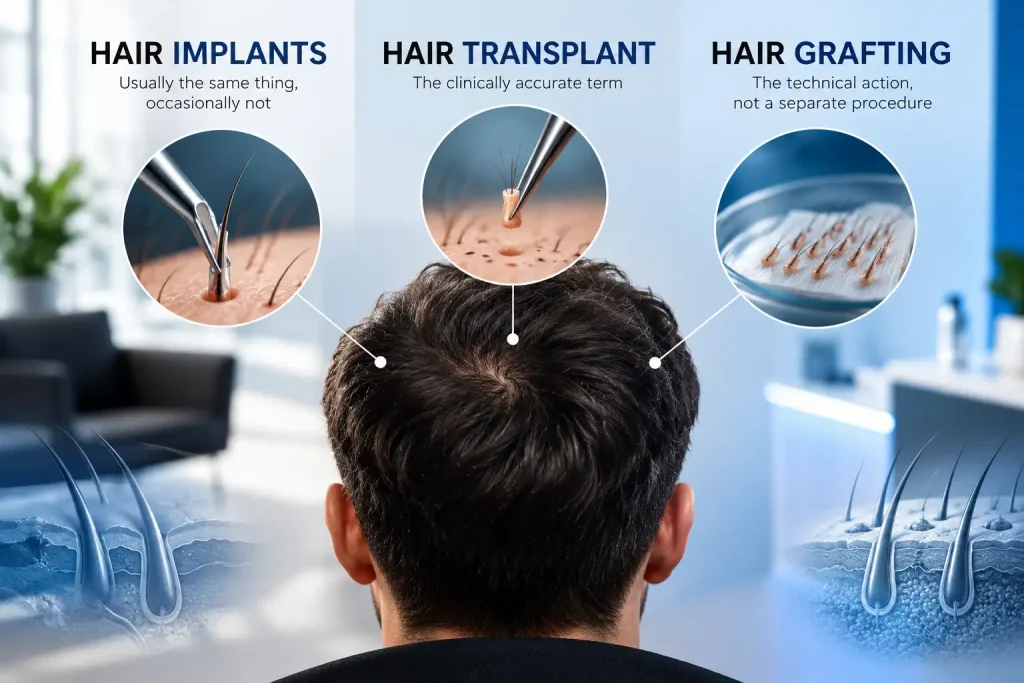
“Hair transplant” is the term surgeons and clinical literature actually use. It describes moving a patient’s own hair follicles from a donor area — almost always the back and sides of the scalp — to an area of thinning or loss. Every technique variation (FUE, FUT, DHI) is a type of hair transplant. For additional patient information, the NHS information on hair transplant procedures provides further general context.
Hair Implants: Usually the Same Thing, Occasionally Not
In everyday search behaviour, “hair implants” is used almost interchangeably with “hair transplant,” and most people typing it mean exactly the same procedure. Worth flagging clearly, though: in a small number of contexts, “hair implant” has historically referred to artificial or synthetic fibre implantation — non-biological material inserted directly into the scalp rather than a patient’s own living follicles. Synthetic hair implantation carries real, well-documented risks, including chronic infection and rejection, and is a different, largely discredited practice compared to a modern, autologous hair transplant. Anyone encountering “hair implants” from an unfamiliar source is right to confirm directly whether real hair follicles or synthetic fibres are being discussed.
“Hair Plantation”: A Common Variant Worth Recognising
Search data shows a significant number of people searching for “hair plantation” specifically — a term more commonly used in South Asian and Middle Eastern English than in standard UK usage, but referring to exactly the same procedure as “hair transplant.” It’s a reminder that unfamiliar phrasing in a search doesn’t necessarily signal an unfamiliar or different treatment, often just a different regional convention for describing it.
Hair Grafting: The Technical Action, Not a Separate Procedure
“Grafting” describes the specific technical act at the centre of a transplant: removing individual follicular units and placing them into the recipient area. When someone asks “how does hair grafting work,” they’re really asking how the transplant procedure itself works. The International Society of Hair Restoration Surgery (ISHRS) guide to hair transplant surgery provides additional information about surgical hair restoration terminology and procedures.
Hair Restoration: The Broadest Umbrella Term
This is where the terminology gets genuinely broader rather than just a synonym. “Hair restoration” covers surgical transplantation, but also non-surgical approaches — PRP therapy, scalp micropigmentation, and medication. A “hair restoration clinic” may or may not perform surgery at all. If surgery specifically is the goal, “hair transplant” is the more precise term to search.
“Hair Restoration Surgery Cost” vs “Hair Transplant Cost”
This distinction has practical consequences when researching price. “Hair restoration cost” can return results spanning medication subscriptions, PRP sessions, and surgery all together, since restoration is the umbrella term. “Hair transplant cost” specifically narrows results to the surgical procedure alone, which is the more useful search when surgery is what’s being priced. Patients comparing treatment costs can also review hair transplant pricing to understand the clinic’s specific pricing information.
A Quick Reference
Hair transplant — the accurate clinical term for the surgical procedure, whichever technique is used
Hair implants — usually a direct synonym; confirm real follicles rather than synthetic fibre if the source is unfamiliar
Hair grafting — the extraction-and-placement action within the procedure, not a separate treatment
Hair restoration — the broadest term, covering surgical and non-surgical options together
Hair replacement (without “surgery”) — often means non-surgical systems like wigs or hairpieces
Hair plantation — a regional variant of “hair transplant,” not a different procedure
City Clinics’ FUE hair transplant page covers the specific technique used here in detail; the grafts-needed guide covers how many are typically required for a given case.
What this means for a patient comparing clinics
The safest comparison is based on the complete treatment pathway rather than a single marketing label. Look at diagnosis, surgeon responsibility, donor planning, treatment design, realistic timelines, complication management and follow-up. Where a clinic makes a treatment-specific claim, keep it clearly attributed to the clinic rather than presenting it as a universal medical fact.
The ISHRS guidance on surgical hair restoration can also be used as a reference when discussing the terminology and treatment pathway.
Questions to take to a consultation
- Ask whether the treatment uses your own follicular units.
- Confirm whether the clinic is discussing surgery or a non-surgical cosmetic option.
- Ask which harvesting method is proposed.
- Ask who performs the surgical stages.
- Read the price inclusions and aftercare before comparing quotes.
Common mistakes to avoid
- Assuming every term is a different treatment.
- Using ‘hair implants’ without checking whether the provider means real follicles.
- Confusing graft count with individual hair count.
- Assuming ‘hair restoration’ always means surgery.
Frequently asked questions
Are hair implants the same as a hair transplant?
In ordinary search language they often refer to the same concept, but terminology is not precise enough to assume that. Confirm exactly what tissue or material is being implanted.
What is a hair graft?
A graft is a follicular unit or prepared group of follicles moved from the donor area to the recipient area.
What does hair plantation mean?
It is a regional search term often used for hair transplantation; it does not describe a distinct modern surgical method.
Is hair restoration the same as a transplant?
No. Hair restoration is a broad term that can include transplantation, medical therapy, PRP and cosmetic camouflage such as SMP.
What should I ask a clinic before booking?
Ask what procedure is proposed, who performs it, how the donor area is assessed, what risks exist and what aftercare is included.
City Clinics context
The clinic-specific details in this article should remain first-party claims and should be checked against the live service page immediately before publication. Current City Clinics pages describe surgeon-led care, one patient per surgeon per day, and a structured aftercare pathway. Those claims should not be generalized to other clinics.
Patients considering the treatment can review the City Clinics FUE hair transplant service for the clinic’s specific information and approach.
For general patient information beyond the clinic’s own materials, the NHS hair transplant guidance provides an independent source of information about the procedure.