In this article
Does PRP Work for Hair Loss in Women?How Does PRP Hair Treatment Work?Why Female-Pattern Hair Loss Needs a Different AssessmentWhat Causes Hair Loss in Women? Check the Diagnosis FirstWho May Be Suitable for PRP for Female Hair Loss?What Results Can Women Expect from PRP?Is PRP Safe for Women?PRP vs Other Treatments for Female Hair LossWhat Should Women Ask Before Choosing a PRP Clinic?PRP for Hair Loss in Women at City ClinicsFrequently Asked QuestionsFinal Thoughts: Is PRP Worth Considering for Women?Sources and Further ReadingPRP for hair loss in women uses the same basic biological principle as PRP for men, but the right treatment depends on why the hair is thinning. Platelet-rich plasma (PRP) is prepared from a small sample of the patient’s own blood and injected into selected areas of the scalp. Research suggests it may improve hair density for some people with female-pattern hair loss, although results vary and the evidence is not conclusive for every type of hair loss.
For women experiencing thinning hair, the first step is to identify the underlying cause. Female-pattern hair loss, postpartum shedding, iron deficiency, thyroid disorders and other conditions can produce different patterns of hair loss and may require different approaches. PRP should therefore be considered as part of an individual treatment plan rather than a universal solution.This guide explains how PRP works, what the evidence suggests about its effectiveness in women, who may be suitable for treatment and what to discuss during a consultation.
Does PRP Work for Hair Loss in Women?
PRP may help some women with female-pattern hair loss by improving hair density, but it does not work equally well for everyone. The outcome depends on the underlying diagnosis, the condition of the hair follicles, the PRP preparation method and the treatment protocol.
PRP is being investigated and used as a treatment for androgenetic alopecia, also known as female-pattern hair loss. Some clinical studies report improvements in hair density following treatment. However, studies differ in their methods, number of sessions, follow-up periods and outcome measurements, making it difficult to predict an individual’s results with confidence.
A 2025 systematic review and meta-analysis examined 43 randomised controlled trials involving 1,877 participants. The researchers reported evidence that activated PRP could improve hair density compared with placebo, while also identifying important differences between treatment protocols and a need for further high-quality research.
These findings are encouraging, but they do not establish that PRP will lead to hair regrowth in every individual. Research involving different types of alopecia also cannot be assumed to demonstrate the same outcomes for all causes of hair loss in women.
For background, read the published review: Platelet-Rich Plasma in the Management of Alopecia: A Systematic Review and Meta-Analysis of Clinical Evidence.
How Does PRP Hair Treatment Work?
PRP stands for platelet-rich plasma. Platelets are components of blood that participate in normal clotting and tissue repair. They also contain signalling molecules and growth factors that are being studied for their potential role in supporting hair follicles.
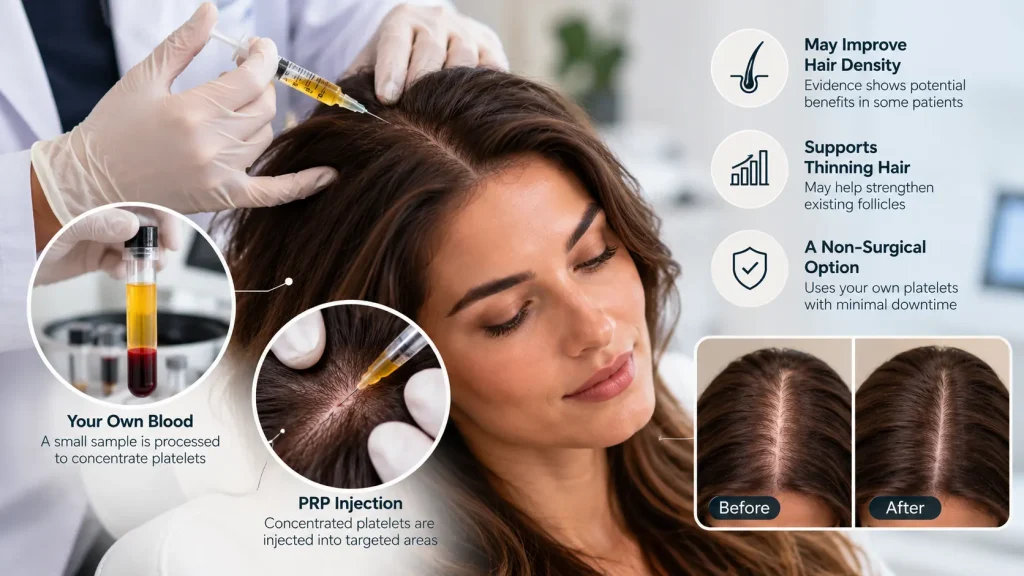
During a typical PRP procedure, a clinician takes a small blood sample and processes it in a centrifuge to separate a platelet-rich fraction. This preparation is then injected into selected areas of the scalp according to the treatment plan.
The intended aim is to support the activity of existing hair follicles. However, PRP preparations are not identical: platelet concentration, processing methods, activation and injection protocols can differ between studies and clinics.
Does the PRP mechanism differ between women and men?
The fundamental procedure is the same. PRP is prepared from the patient’s own blood and delivered to the scalp, regardless of sex. What differs is the clinical context in which it is being considered.
Women may experience diffuse thinning across the top of the scalp, a widening parting, temporary shedding after pregnancy or hair loss associated with an underlying medical or nutritional issue. Identifying the cause is essential because the treatment that makes sense for one pattern may not be appropriate for another.
PRP is not a way to create entirely new hair follicles in areas where follicles have been permanently destroyed. Its potential benefit is generally discussed in relation to existing follicles and particular forms of non-scarring hair loss.
Why Female-Pattern Hair Loss Needs a Different Assessment
Female-pattern hair loss commonly causes gradual thinning over the crown and top of the scalp. The central parting may become wider, and the scalp may become more visible over time. The frontal hairline is often relatively preserved, although presentations vary.
However, not all hair loss in women follows this pattern. Sudden or widespread shedding may be associated with illness, stress, childbirth, medication changes or other triggers. Some conditions can also cause inflammation or permanent scarring and require prompt assessment.
This distinction matters when considering PRP. Evidence for PRP in female-pattern hair loss should not be assumed to apply equally to postpartum shedding, nutritional deficiencies, thyroid-related hair loss or scarring alopecia.
PRP and diffuse thinning
Because PRP does not require hair follicles to be transplanted from a donor area, it may be considered by women who have diffuse thinning and are not suitable candidates for hair transplantation.
Hair transplantation is a separate procedure that involves relocating follicles from a donor area to a recipient area. In women with widespread thinning, the donor area may also be affected, making careful assessment particularly important. Some women may still be suitable for surgery, while others may benefit more from medical treatment or non-surgical options.
PRP should not automatically be described as a replacement for a transplant. The appropriate option depends on the diagnosis, the distribution of thinning, donor hair quality, treatment goals and the clinician’s assessment.
Explore the broader options available through City Clinics’ female hair restoration service.
What Causes Hair Loss in Women? Check the Diagnosis First
Before committing to PRP, it is important to establish what is causing the hair loss. Several conditions can look similar at first but require different treatment approaches.
1. Female-pattern hair loss
This usually develops gradually and may cause a widening parting or reduced density across the top of the scalp. Treatment options can include established medical therapies and, in selected cases, other clinician-directed treatments. PRP may be discussed as an additional option, depending on the diagnosis and the individual’s circumstances.
A clinical review of female-pattern hair loss identifies established medical therapies as important treatment options with a stronger evidence base than many alternative approaches. PRP should therefore be discussed alongside appropriate medical options rather than assumed to be the first or only choice.
Read the review: Female-pattern hair loss: therapeutic update.
2. Postpartum hair shedding
Some women experience increased shedding in the months after giving birth. This is often related to changes in the hair growth cycle and may improve over time. Persistent, severe or unusual shedding should be assessed rather than automatically treated with PRP.
3. Iron deficiency or nutritional concerns
Iron deficiency and inadequate nutrition can contribute to hair loss in some people. Supplements should not be started at high doses simply because hair is thinning. A clinician can determine whether a deficiency is plausible, whether testing is appropriate and whether treatment is needed.
4. Thyroid conditions and other medical causes
Thyroid dysfunction and certain other medical conditions may affect hair growth. Depending on the history and examination, a clinician may recommend further investigation or blood tests before selecting a hair-loss treatment.
5. Medication-related or inflammatory hair loss
Some medicines can contribute to shedding, while inflammatory or scarring scalp conditions may need specialist assessment. Do not stop prescribed medication without speaking to the prescribing clinician. Sudden, patchy or painful hair loss, scalp inflammation or loss of eyebrow hair should be assessed rather than managed with PRP alone.
The NHS provides further information about the causes and management of hair loss in women: NHS guidance on women and hair loss.
Who May Be Suitable for PRP for Female Hair Loss?
PRP may be considered for some women with diagnosed female-pattern hair loss, particularly when the aim is to support existing hair rather than replace follicles in completely bald areas. Suitability must be assessed individually.
A consultation should consider:
- The diagnosis: Is the hair loss consistent with female-pattern hair loss, or is another cause more likely?
- The pattern and duration: Is the thinning gradual and diffuse, sudden, patchy or associated with scalp symptoms?
- Follicle condition: Is there existing hair in the treatment area, and are there signs that require a different approach?
- Medical history: Are there relevant conditions, medicines or other factors that may affect treatment suitability?
- Alternative options: Would established medical treatment, investigation of a reversible cause or another intervention be more appropriate?
- Expectations: Is the goal to support density or reduce shedding, and is that goal realistic for the individual’s diagnosis?
PRP is not automatically suitable for every patient. The clinician should explain the expected benefits, uncertainties, possible risks and available alternatives before treatment begins.
What Results Can Women Expect from PRP?
Where PRP is considered appropriate, potential treatment goals may include improving hair density or reducing hair shedding. However, individual responses vary, and visible improvement is not assured.
It is important to distinguish between supporting existing hair follicles and restoring hair in areas where follicles may no longer be capable of producing hair. PRP should not be described as a treatment that will necessarily restore a full head of hair or regrow hair in completely bald areas.
How long does PRP take to show results?
Hair growth changes gradually, so treatment outcomes cannot be judged immediately after an injection. Any improvement needs to be assessed over an appropriate follow-up period, taking the individual’s diagnosis and treatment plan into account.
Before starting, ask the clinician when progress should be reviewed, how it will be measured and what the next step will be if the response is limited. Standardised photographs taken under consistent lighting and with similar hair positioning may help track visible changes over time.
How many PRP sessions will women need?
There is no single session schedule that can be assumed to suit every woman. The number and timing of sessions depend on the clinic’s protocol, the diagnosis, the individual’s response and the available evidence supporting that approach.
Ask for a clear explanation of the proposed course, the total cost, review appointments and whether maintenance treatment is being recommended. Be cautious of claims that promise a specific result after a fixed number of sessions.
Is PRP Safe for Women?
Because PRP is prepared from the patient’s own blood, the risk of an immune reaction to donor material is avoided. However, this does not mean that the procedure is safe!
Possible temporary effects include discomfort or tenderness, redness, swelling and bruising around the treated areas. As with other injectable procedures, infection and other complications are possible, although the individual risk depends on the procedure and clinical circumstances.
Before treatment, discuss your medical history, medicines, relevant bleeding or platelet-related conditions, and any factors that could affect suitability. The clinician should explain the preparation method, infection-control measures, expected recovery and how complications would be managed.
Do not assume that a treatment is suitable simply because it uses material from your own body. An appropriate clinical assessment is still necessary.
PRP vs Other Treatments for Female Hair Loss
PRP is one option among several, and it should be compared with treatments that address the specific cause of hair loss.
| Treatment option | Potential role | Important consideration |
|---|---|---|
| PRP therapy | May improve hair density for some people with suitable types of hair loss. | Results vary, protocols differ and more standardised research is needed. |
| Established medical treatment for female-pattern hair loss. | An established treatment for female-pattern hair loss. | Suitability, use, possible side effects and ongoing treatment should be discussed with a clinician. |
| Treatment of an underlying cause | May address shedding associated with a medical condition or confirmed deficiency. | The cause must be identified; unnecessary supplements or treatment may not help. |
| Hair transplantation | Can relocate follicles in carefully selected candidates. | Donor hair quality and the pattern of thinning are important, particularly in women with diffuse loss. |
| Other clinician-directed options | May be appropriate depending on the diagnosis and individual circumstances. | Benefits, risks and evidence vary by treatment. |
The right choice is not necessarily the newest or most heavily promoted treatment. It is the option—or combination of options—that best matches the diagnosis, clinical evidence, personal preferences and realistic treatment goals.
What Should Women Ask Before Choosing a PRP Clinic?
When comparing clinics, look beyond the treatment name or advertised session price. A responsible treatment pathway should begin with an assessment and include clear information about the proposed procedure, its limitations and follow-up.
Consider asking these questions during your consultation:
- What type of hair loss do you think I have, and how was it assessed?
- Should any reversible or medical causes be investigated before treatment?
- Why are you recommending PRP for my particular pattern of thinning?
- What does the current evidence suggest for someone with my diagnosis?
- What improvement is realistic, and how will it be measured?
- How many sessions are proposed, and what is the full course cost?
- Are maintenance sessions recommended, and what evidence supports that schedule?
- What are the possible side effects, and who will manage complications?
- What alternatives should I consider, including established medical treatments?
- When will my progress be reviewed, and what happens if treatment does not help?
PRP for Hair Loss in Women at City Clinics
At City Clinics, PRP therapy is presented as a treatment using platelet-rich plasma prepared from the patient’s own blood and injected into selected areas of the scalp. It may be considered as a standalone treatment or within a broader hair-restoration plan, depending on the clinical assessment.
PRP is not suitable for every cause of female hair loss. The appropriate starting point is to understand the pattern of thinning, consider whether further investigation is needed and discuss which treatment options are realistic for the individual patient.
Explore the service to learn more about the procedure and arrange a discussion about suitability: Discover PRP Therapy at City Clinics.
For a broader overview of treatment pathways for women, visit the Female Hair Restoration service. For information about the clinic’s post-treatment guidance, see City Clinics Aftercare.
Frequently Asked Questions
Does PRP work for female-pattern hair loss?
PRP may improve hair density in some women with female-pattern hair loss. Research findings are encouraging but variable, and individual outcomes are not assured. A diagnosis and individual clinical assessment are important before choosing treatment.
Is PRP different for women than for men?
The basic PRP procedure is the same, but the cause and pattern of hair loss may differ. Women can experience female-pattern thinning, postpartum shedding and hair loss related to medical or nutritional factors. These differences influence whether PRP is appropriate.
Can PRP help postpartum hair loss?
Hair shedding after childbirth often relates to changes in the hair growth cycle and may improve over time. PRP should not automatically be used as the first response. Persistent or unusual shedding should be assessed to determine the cause and appropriate management.
Can PRP treat hair loss caused by iron deficiency or thyroid problems?
PRP does not replace the investigation and management of an underlying deficiency or medical condition. Where iron deficiency, thyroid dysfunction or another cause is suspected, a clinician can advise whether testing and targeted treatment are needed.
Can PRP regrow hair in completely bald areas?
PRP is generally considered for its potential effects on existing hair follicles. It cannot be relied on to restore hair in areas where follicles have been permanently destroyed. The cause of the bald area needs to be established before treatment is considered.
How does PRP compare with other hair-loss treatments for women?
There is not enough consistent evidence to establish that PRP is more effective than other established treatments for female-pattern hair loss. Some medical treatments have a stronger evidence base, while PRP has shown promising but variable results in clinical studies. A qualified clinician can explain the potential benefits, limitations and suitability of available options based on your individual circumstances.
Do women need blood tests before PRP?
Not every patient necessarily needs the same tests. Depending on the history and examination, a clinician may consider investigations for iron deficiency, thyroid dysfunction or other possible causes of hair loss before recommending treatment.
How long do PRP results last?
The duration of any benefit varies, and long-term outcomes are not predictable for every patient. Ask the clinic how it assesses results, what follow-up is proposed and whether maintenance is being recommended for your particular diagnosis.
Final Thoughts: Is PRP Worth Considering for Women?
PRP can be a reasonable option to discuss for selected women with female-pattern hair loss, particularly when the aim is to support existing hair and improve density. However, its effectiveness varies, and it should not be presented as a universal treatment for all forms of female hair loss.
The most useful first step is to identify the cause of hair thinning, consider established treatments and understand what PRP may realistically achieve. An informed decision should be based on the diagnosis, available research evidence, the proposed treatment plan and clear follow-up expectations rather than promises of hair regrowth.
Considering PRP? Learn more about PRP Therapy at City Clinics and discuss whether it may be appropriate for your hair-loss pattern.
Sources and Further Reading
- Platelet-Rich Plasma in the Management of Alopecia: A Systematic Review and Meta-Analysis of Clinical Evidence (2025)
- Female-pattern hair loss: therapeutic update (2023)
- NHS: Women and hair loss
- City Clinics: PRP Therapy
- City Clinics: Female Hair Restoration
Medical disclaimer: This article is intended for general educational purposes and does not replace individual medical advice, diagnosis or treatment. Hair loss can have several causes, and treatment suitability should be assessed by a qualified healthcare professional.