In this article
Quick Answer: Does PRP for Hair Loss Work?What Is PRP Therapy for Hair Loss?What Does the Scientific Evidence Say About PRP for Hair Growth?PRP for Hair Loss: What the Evidence Does and Does Not ShowWhat Type of Hair Loss May Respond to PRP?What Does PRP Do Well—and What Are Its Limitations?How Many PRP Sessions Are Needed for Hair Growth?How Long Does PRP Take to Work?Is PRP for Hair Loss Permanent?What Are the Risks and Side Effects of PRP?How Much Does PRP Hair Treatment Cost?Questions to Ask Before Booking PRPCommon Misconceptions About PRP for Hair LossHow City Clinics Approaches PRP TherapyFrequently Asked Questions About PRP for Hair LossFinal Verdict: Is PRP for Hair Loss Worth Considering?Sources and Further ReadingDoes PRP for hair loss actually work? Research suggests that platelet-rich plasma (PRP) may improve hair density in some people with androgenetic alopecia, also known as male or female pattern hair loss. However, the strength of the evidence varies, treatment protocols differ between studies, and individual results may vary. PRP is a treatment option to discuss with a qualified clinician—not a proven cure for every type of hair loss.
PRP has attracted considerable interest because it uses a concentrated component of a patient’s own blood rather than a conventional hair-growth medicine. Some clinical studies have reported improvements in hair density, but researchers continue to investigate which preparation methods, treatment schedules and patient groups are most likely to benefit.If you are considering PRP for hair loss, it is worth understanding what the research shows, what the treatment involves, how long results may take, and how it compares with other options before committing to a course.
Quick Answer: Does PRP for Hair Loss Work?
PRP may improve hair density in some people with androgenetic alopecia. Systematic reviews and meta-analyses have reported encouraging results, including improvements in hair density compared with placebo in some studies. However, differences in PRP preparation, injection schedules, study quality and patient characteristics make it difficult to predict an individual’s outcome.
PRP is generally considered a potential option for selected patients who still have hair follicles capable of producing hair. It should not be presented as a reliable way to restore hair in long-standing bald areas where viable follicles are no longer present.
The key point: PRP may help some patients, but diagnosis, realistic expectations and an appropriate treatment plan matter more than a promise of regrowth.
What Is PRP Therapy for Hair Loss?
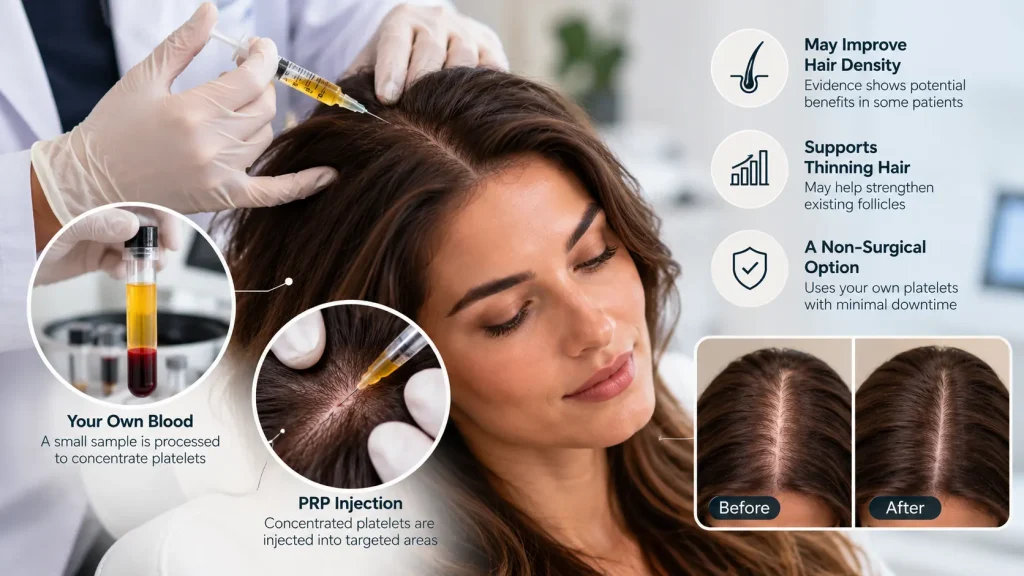
PRP stands for platelet-rich plasma. It is prepared from a small sample of the patient’s own blood. The sample is processed, usually using a centrifuge, to separate a platelet-rich portion of the plasma. This preparation is then injected into selected areas of the scalp.
Platelets contain growth factors and signalling molecules involved in normal tissue repair and biological processes. Researchers are investigating whether concentrated platelets can help support hair follicles and improve hair growth in certain types of hair loss.
Although the treatment has a biological rationale, this does not mean every PRP preparation will produce the same effect. The concentration of platelets, preparation technique, whether the PRP is activated, injection method and treatment schedule can differ between clinics and clinical studies.
City Clinics explains its procedure on the PRP Therapy page, including how blood is collected, processed and returned to the scalp. The details of a particular clinic’s treatment protocol should not be assumed to apply to every PRP service.
What Does the Scientific Evidence Say About PRP for Hair Growth?
The evidence is encouraging, but it needs to be interpreted carefully. Several systematic reviews and meta-analyses have examined PRP for androgenetic alopecia. Some have reported increased hair density following treatment, while also identifying limitations in the available research.
What the 2025 systematic review found
A systematic review and meta-analysis published in 2025 assessed 43 randomised controlled trials involving 1,877 participants with alopecia. The researchers evaluated outcomes including hair density, hair thickness, side effects and patient satisfaction.
The review reported that activated PRP was associated with increased hair density and reduced recurrence compared with placebo. It also identified differences in outcomes and adverse effects between PRP approaches.
These findings support continued investigation of PRP, but they do not establish that every preparation method is equally effective or that every patient will experience noticeable regrowth. The findings need to be considered alongside the differences between the included trials.
Read the study: Platelet-Rich Plasma in the Management of Alopecia: A Systematic Review and Meta-Analysis of Clinical Evidence.
What earlier randomised trials found
A 2023 systematic review and meta-analysis examined nine randomised controlled trials involving 238 participants with androgenetic alopecia. The researchers reported statistically significant improvements in hair density at three and six months compared with placebo.
However, the analysis did not find a statistically significant advantage over placebo for every measured outcome, including certain comparisons involving hair count and hair diameter. The authors also noted that the evidence came from a relatively small number of trials.
This is an important distinction: an improvement in one measured outcome does not prove that every aspect of hair growth will improve or that the treatment will deliver a dramatic cosmetic change.
Read the study: Platelet-Rich Plasma for Androgenetic Alopecia: A Systematic Review and Meta-Analysis of Randomized Controlled Trials.
What research on female hair loss tells us
A 2024 systematic review and meta-analysis specifically examined PRP for female hair loss. This is relevant because findings from studies involving mixed populations or predominantly male participants should not automatically be treated as definitive evidence for every woman.
The review adds to the evidence that PRP may be useful for some women, but individual suitability and the certainty of the expected benefit still require careful consideration.
Read the study: Effectiveness of platelet-rich plasma in treating female hair loss: A systematic review and meta-analysis of randomized controlled trials.
PRP for Hair Loss: What the Evidence Does and Does Not Show
| Question | What the evidence suggests | Important limitation |
|---|---|---|
| Can PRP improve hair density? | Some clinical studies and meta-analyses report increased hair density. | The size and consistency of the benefit vary between studies and patients. |
| Can PRP improve hair thickness? | Some studies report improvements in hair-related measurements. | Results are not consistent across all outcomes or comparisons. |
| Does PRP work for every type of hair loss? | Most of the relevant evidence concerns androgenetic alopecia. | Results should not be generalised to all causes of shedding or scalp disease. |
| Can PRP restore a completely bald area? | PRP may support existing, viable follicles. | It should not be presented as a way to recreate follicles that are no longer viable. |
| Are results permanent? | Some patients may experience benefits over a period of time. | Long-term durability and maintenance requirements are not established as a universal outcome. |
| Is there one proven treatment schedule? | Clinical studies have examined different schedules and preparation methods. | There is no single protocol that can be assumed to be optimal for every patient. |
Overall, the evidence supports cautious optimism rather than certainty. PRP may be worth discussing with a clinician, but it should be assessed as one option within a broader hair-loss treatment plan.
What Type of Hair Loss May Respond to PRP?
PRP research has focused substantially on androgenetic alopecia, commonly called pattern hair loss. This condition can cause gradual thinning as hair follicles produce progressively finer hairs.
Some people with early or moderate pattern thinning may be suitable for consideration of PRP, depending on their diagnosis, scalp condition, medical history and treatment goals. However, the stage of hair loss alone cannot determine whether treatment will work.
PRP for male pattern hair loss
PRP has been investigated in men with androgenetic alopecia, with several studies reporting improvements in hair density. It may be discussed as a standalone option or as part of a wider treatment plan, depending on the individual’s circumstances.
PRP for female hair loss
PRP has also been studied in women with pattern hair loss. Women can experience different patterns of thinning and may have additional contributors to shedding, including medical conditions or nutritional deficiencies.
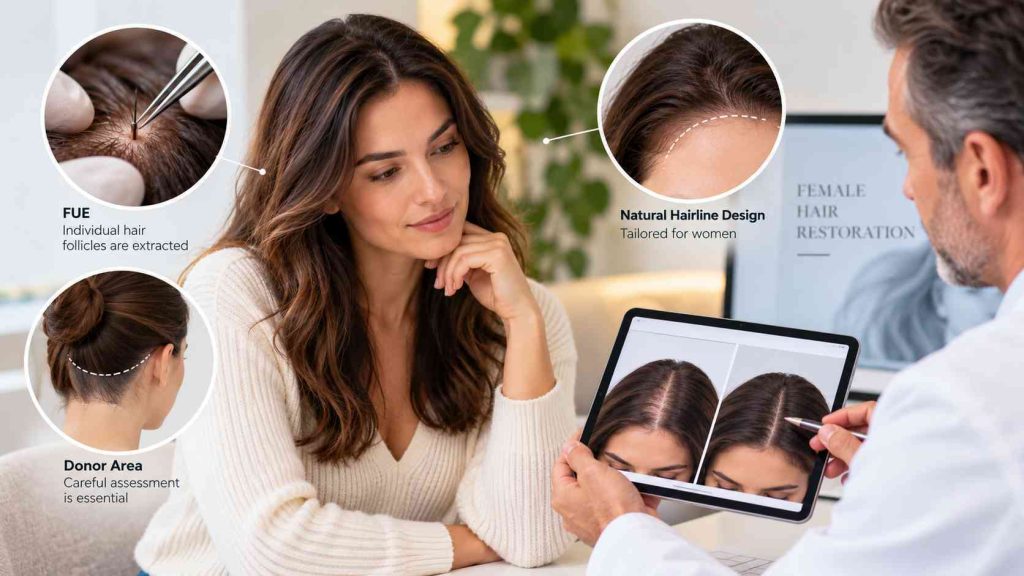
Before considering PRP, it is important to establish whether the hair loss is female-pattern hair loss or another condition that requires a different approach. You can explore the assessment pathway on the City Clinics Female Hair Restoration page.
What about sudden or diffuse shedding?
Sudden or widespread shedding can have causes that differ from androgenetic alopecia. These may include illness, significant weight changes, nutritional problems, thyroid dysfunction, hormonal changes or medication-related effects.
PRP should not be assumed to be the appropriate first treatment for unexplained shedding. A GP or appropriately qualified clinician can assess the pattern, history and symptoms and decide whether investigations or another treatment are needed.
What Does PRP Do Well—and What Are Its Limitations?
The most reasonable way to describe PRP is as a treatment that may help improve certain hair-growth outcomes in selected patients. It is not a definitive cure, and it does not replace a proper diagnosis.
Potential benefits
- Some clinical studies report improvements in hair density.
- It uses a blood sample taken from the patient, rather than donor blood.
- It is a non-surgical procedure, although it does involve injections.
- It may be considered as one option within an individualised hair-loss treatment plan.
Important limitations
- Not every patient responds to treatment.
- Research findings vary according to PRP preparation, treatment schedule and study design.
- It is not a proven solution for every type of hair loss.
- It should not be expected to restore hair where viable follicles are no longer present.
- Repeat treatment or maintenance may be proposed, creating additional time and cost commitments.
- Long-term outcomes remain uncertain, and individual results may vary.
A responsible consultation should explain both the potential benefits and the limitations before you decide whether PRP is appropriate.
How Many PRP Sessions Are Needed for Hair Growth?
The number of PRP sessions varies depending on the treatment protocol and the patient’s individual circumstances. Research studies use different treatment schedules, and a qualified clinician can recommend an appropriate approach based on the patient’s needs and treatment goals.
Before starting treatment, ask the provider to explain:
- How many initial sessions are proposed and how far apart they will be.
- Why that schedule is being recommended for your diagnosis.
- How the clinic prepares the PRP and whether it uses an activation step.
- When progress will be reviewed and how it will be measured.
- Whether further sessions or maintenance are likely to be recommended.
- What the complete course is expected to cost.
City Clinics states that four PRP sessions are included in its surgical aftercare programme. Its standalone PRP pathway is a separate offering, and the appropriate schedule should be confirmed directly with the clinic. This is a clinic-specific arrangement, not a universal treatment recommendation.
For details, visit the City Clinics PRP Therapy page.
How Long Does PRP Take to Work?
PRP is not an instant hair-growth treatment. Clinical studies commonly assess hair-related outcomes over several months, including follow-ups at around three and six months. The timing and extent of improvement may vary from person to person.
Hair growth occurs in cycles, and visible changes can take time. If you are undergoing treatment, ask your clinician when an assessment is appropriate and what kind of improvement is realistic for your starting condition.
Standardised photographs taken under consistent lighting, with the same hair parting and camera position, can help document changes more reliably than memory alone. Hair density measurements may also be useful where available.
Be cautious of claims based on a single photograph without a clear timeline, consistent conditions or an explanation of other treatments used at the same time.
Is PRP for Hair Loss Permanent?
PRP should not be described as a permanent solution to hair loss. Although some patients may experience benefits, the duration of any improvement varies, and the evidence does not establish a single maintenance schedule that works for everyone.
Androgenetic alopecia can continue to progress over time. A treatment that improves hair density at one point does not necessarily prevent future thinning.
Ask your clinician how long the expected benefit may last, when progress will be reviewed and whether further sessions may be appropriate. The decision should be based on your response, treatment goals and the evidence available—not an automatic commitment to repeated procedures.
PRP and other hair-loss treatment options work in different ways. PRP is a procedure that has shown promising results in some clinical studies for improving hair density in certain patients.
Research has not established PRP as the most effective option for everyone. Findings vary across studies, and treatment outcomes depend on factors such as the type of hair loss, the treatment approach and individual circumstances.
Depending on the diagnosis, a qualified clinician may discuss different hair-loss management options. The decision should take into account the available evidence, potential side effects, practical considerations, costs and individual preferences.
Do not change an existing treatment plan or combine treatments without consulting an appropriately qualified healthcare professional.
What Are the Risks and Side Effects of PRP?
PRP involves taking blood and injecting the prepared material into the scalp. It may cause temporary tenderness, redness, swelling, bruising or discomfort at the injection sites.
Because the procedure involves injections, there are also potential risks such as bleeding or infection. The patient’s medical history and circumstances may affect suitability, so the provider should review relevant health information and explain the risks before treatment.
Ask the clinician what side effects are expected, what symptoms should prompt medical advice, what aftercare is recommended and whom to contact if a problem develops.
City Clinics provides its own post-treatment guidance on the Aftercare page. Follow the instructions provided for your actual procedure, as advice may vary depending on the treatment received.
How Much Does PRP Hair Treatment Cost?
The cost of PRP for hair loss varies according to the clinic, treatment protocol, number of sessions and whether the procedure is offered independently or as part of a wider treatment package.
Before choosing a provider, ask for a clear breakdown of the full course rather than comparing only the price of a single appointment. A lower initial price may not reflect the total cost if repeat sessions are recommended.
Questions worth asking include:
- What is included in the quoted price?
- How many sessions does the proposed course include?
- Are follow-up reviews or maintenance sessions charged separately?
- What evidence supports the proposed protocol?
- How will the clinic document and evaluate my response?
- What alternatives are available, and how do their costs compare?
The most useful comparison considers the diagnosis, clinical oversight, treatment plan, realistic expectations and follow-up—not price alone.
Questions to Ask Before Booking PRP
A consultation should help you decide whether PRP is suitable, not simply persuade you to buy a course. Consider asking:
- What is causing my hair loss? Ask how the diagnosis was established and whether additional assessment is needed.
- What evidence supports PRP for my condition? Ask whether the available research applies to your particular pattern of hair loss.
- Which PRP protocol will you use? Ask about preparation, treatment intervals and the rationale for the schedule.
- What outcome is realistic? Clarify whether the aim is improved density, thicker existing hair or reduced shedding.
- How will progress be measured? Ask about photographs, clinical measurements and review appointments.
- What are the risks and alternatives? Discuss medical treatments, other appropriate options and the possibility that PRP may not help.
- What is the total cost? Confirm the price of the proposed course and any possible maintenance sessions.
- What happens if I do not respond? Ask how the treatment plan will be reassessed and what the next steps may be.
Common Misconceptions About PRP for Hair Loss
“PRP is a cure for baldness.”
PRP may help improve hair density in some patients, but it is not a definitive cure. Results vary between individuals, and it may not restore hair in every area affected by hair loss.
“One session will regrow my hair.”
Research generally evaluates outcomes over time and uses different treatment schedules. A single session should not be assumed to provide a meaningful or lasting result.
“PRP works for every type of hair loss.”
Most of the relevant evidence focuses on androgenetic alopecia. Other conditions may require different investigations or treatments.
“Results are permanent.”
The durability of any benefit varies, and the evidence does not establish a universal permanent outcome. Hair loss may continue to progress even after an initial improvement.
“Before-and-after photographs prove the treatment works.”
Photographs can help document a patient’s progress, but they should be interpreted alongside the timeline, consistency of the images, diagnosis and any other treatments used. One example cannot establish what another patient should expect.
How City Clinics Approaches PRP Therapy
City Clinics offers PRP as a standalone treatment and describes PRP sessions as part of its hair-transplant aftercare programme. Its website explains the blood collection, processing and injection stages, as well as the role it intends PRP to play in supporting hair growth.
These details describe the clinic’s service and treatment pathway. They should not be interpreted as independent proof that its particular protocol produces a specific result for every patient.
If you are considering PRP, the first step is to establish whether the treatment is appropriate for your diagnosis and goals. A consultation should cover the evidence, limitations, possible risks, costs and alternatives before you decide to proceed.
Explore the service directly on the City Clinics PRP Therapy page.
Frequently Asked Questions About PRP for Hair Loss
Does PRP for hair loss actually work?
Research suggests PRP may improve hair density in some people with androgenetic alopecia. However, results vary between individuals, treatment protocols differ across studies, and outcomes depend on individual circumstances.
Can PRP regrow hair in a completely bald area?
PRP may help support existing, viable hair follicles, but it should not be presented as a way to recreate follicles that are no longer present or viable. A clinician can assess which treatment options may be appropriate for an area of established hair loss.
How many PRP sessions are needed for hair growth?
The number of sessions depends on the treatment protocol and the individual’s needs. Research studies and clinics use different schedules. A qualified clinician can recommend a suitable treatment plan and explain the expected course, follow-up requirements and total cost.
How long does PRP take to show results?
Studies commonly assess hair-related outcomes over several months. Individual responses vary, and the timing of any improvement may differ from person to person.
Is PRP a permanent hair-loss treatment?
No permanent result can be promised. Any benefit may change over time, and the underlying hair-loss condition may continue to progress. Maintenance should be discussed individually rather than assumed to be necessary on a fixed schedule.
Is PRP effective for female hair loss?
Research has investigated PRP in women with pattern hair loss and suggests potential benefits in some patients. However, female hair loss has several possible causes, so the diagnosis should be established before treatment is considered.
How does PRP compare with other hair-loss treatments?
There is no established universal winner. Both treatments have different evidence bases, practical considerations and potential limitations. A clinician can help compare them based on the diagnosis and individual circumstances.
Is PRP painful?
PRP involves injections into the scalp, so some discomfort may occur. The experience varies, and the provider can explain what to expect and what measures may be used to manage discomfort.
Does PRP have side effects?
Possible effects include temporary tenderness, redness, swelling or bruising. Injection procedures can also carry risks such as bleeding or infection. Discuss your medical history and the procedure’s risks with the clinician beforehand.
Final Verdict: Is PRP for Hair Loss Worth Considering?
PRP is a promising treatment option for selected people with androgenetic alopecia. Systematic reviews and clinical trials have reported improvements in hair density, but differences in treatment protocols and study quality mean that the results should be interpreted cautiously.
PRP is not a definitive cure or a permanent solution for everyone, and it may not restore hair in areas with extensive hair loss. Its suitability depends on the cause and pattern of hair loss, the condition of the scalp, individual health factors and realistic treatment goals.
Before booking a course, establish the likely cause of your hair loss, compare appropriate alternatives and ask how treatment success will be measured. A well-informed decision should include the potential benefits, limitations, risks, full cost and follow-up plan.
Considering PRP? Visit the City Clinics PRP Therapy page to learn about the clinic’s service and arrange a consultation to discuss individual suitability.
Sources and Further Reading
- 2025 systematic review and meta-analysis: Platelet-Rich Plasma in the Management of Alopecia
- 2023 systematic review and meta-analysis: PRP for Androgenetic Alopecia
- 2024 systematic review and meta-analysis: PRP for Female Hair Loss
- 2024 systematic review: The Role of PRP in Androgenetic Alopecia
- 2024 systematic review and meta-analysis: PRP and Hair Density in Androgenetic Alopecia
- City Clinics: PRP Therapy
- City Clinics: Female Hair Restoration
- City Clinics: Aftercare
Medical disclaimer: This article is for general educational purposes and does not replace individual medical advice, diagnosis or treatment. The suitability of PRP or another hair-loss treatment should be assessed by an appropriately qualified healthcare professional.