In this article
Quick Answer: Can Women Get Hair Transplants?Female Hair Transplants at a GlanceWhat Is a Female FUE Hair Transplant?Why Is Female Hair Transplant Assessment Different from Male Assessment?Who Is a Good Candidate for a Female Hair Transplant?When Might a Hair Transplant Not Be Suitable for Women?How Is the Female Hairline Designed?Do Women Need to Shave Their Heads for FUE?What Happens During a Female Hair Transplant Consultation?What Is Recovery Like After a Female FUE Hair Transplant?Can Female Hair Loss Be Treated Without Surgery?Female Hair Transplant vs Non-Surgical Treatment: How Do You Choose?How to Choose a Female Hair Restoration Clinic in the UKFemale Hair Restoration at City Clinics, LondonFrequently Asked Questions About Female Hair TransplantsMedical DisclaimerSources and Further ReadingYes, women can get hair transplants, and selected women may benefit from follicular unit extraction (FUE).
However, not every woman experiencing hair thinning is a suitable candidate for surgery. Eligibility depends on the cause of hair loss, the stability and quality of the donor area, the distribution of thinning and the individual’s treatment goals.Female hair transplantation requires careful planning because hair loss in women often presents differently from the typical male pattern. While some women have a clearly defined area of thinning, others experience diffuse hair loss across the scalp. In the latter situation, the donor area may also be affected, making it more difficult to determine whether transplantation is appropriate.For women researching hair restoration in the UK, understanding these differences is an important first step. This guide explains how female FUE works, who may be suitable for a hair transplant, why donor-area assessment matters, how female hairline design differs, and which non-surgical options may be worth considering before surgery.
Quick Answer: Can Women Get Hair Transplants?
Yes. Women can undergo hair transplantation when the cause and pattern of hair loss, donor-hair availability and overall clinical assessment indicate that surgery is appropriate. FUE is one technique that may be considered for suitable female patients.
The main challenge is often identifying a stable donor area. Female-pattern hair loss can affect a wider area of the scalp than typical male-pattern hair loss, and some women experience thinning in both the recipient and donor regions.
Women with a clearly defined area of hair loss and an adequate, stable donor supply may be considered for transplantation. Women with widespread thinning, active shedding, untreated medical causes or certain scalp conditions may need further investigation or non-surgical management instead.
The most appropriate next step is to establish the diagnosis and assess the donor area before discussing graft numbers, hairline design or surgical outcomes.
Female Hair Transplants at a Glance
The following table summarises the main considerations for women exploring hair transplantation.
| Consideration | What women should know | Why it matters |
|---|---|---|
| Eligibility | Some women are suitable candidates, while others may benefit more from medical treatment or further investigation. | The cause and pattern of hair loss influence the appropriate treatment. |
| FUE technique | Individual follicular units are extracted from a donor area and implanted in a planned recipient area. | The technique must be adapted to the patient’s anatomy, hair characteristics and treatment goals. |
| Donor-area stability | The back and sides of the scalp must be assessed rather than automatically assumed to be suitable. | Donor hair may also be affected by diffuse thinning or follicular miniaturisation. |
| Hair loss pattern | A clearly defined area of loss may be easier to assess surgically than widespread thinning. | The distribution of loss helps determine whether transplantation is appropriate. |
| Hairline design | Female hairlines are planned according to individual facial features, existing hair and natural growth direction. | A suitable design should complement the patient’s appearance rather than copy a standard male hairline. |
| Shaving and preparation | Preparation requirements vary. Some treatment plans may involve partial shaving, while others require different arrangements. | Patients should understand the practical implications before committing to surgery. |
| Alternatives to surgery | Medical treatment, management of underlying conditions and selected supportive therapies may be appropriate. | Surgery does not treat every cause of female hair loss. |
| Long-term planning | Native hair may continue to thin after a transplant. | A sustainable plan should consider future hair loss, donor limitations and follow-up care. |
What Is a Female FUE Hair Transplant?
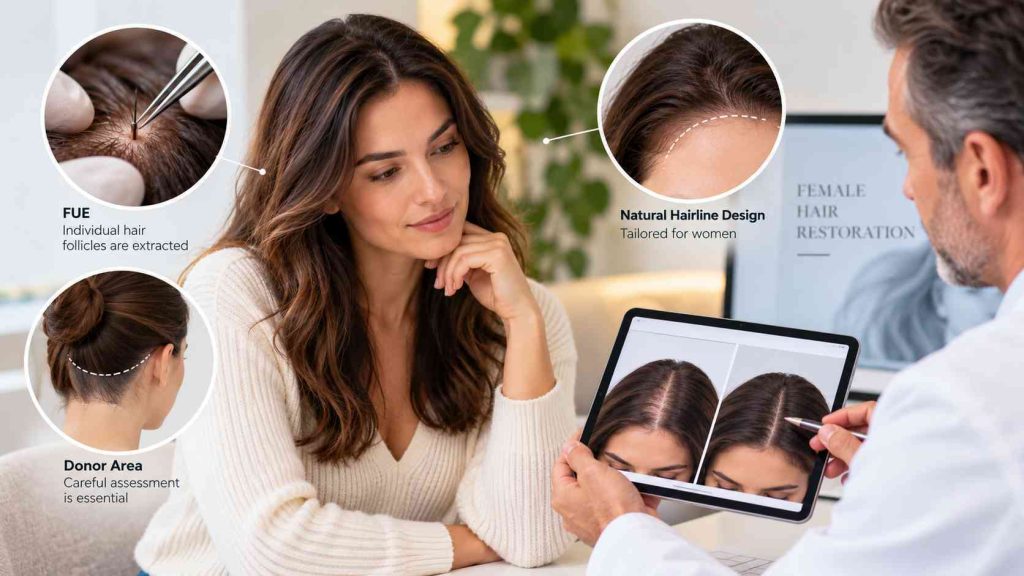
Follicular unit extraction, commonly known as FUE, is a hair transplantation technique in which individual follicular units are removed from a donor area and implanted into a recipient area where additional hair coverage is desired.
Although FUE is used for both male and female patients, the technique alone does not determine whether someone is suitable for surgery. The diagnosis, distribution of hair loss, donor-area characteristics and treatment objectives are equally important.
How does FUE work?
A typical FUE procedure involves several stages:
- Clinical assessment: The clinician evaluates the pattern of hair loss, medical history, scalp condition and suitability for transplantation.
- Donor-area planning: The available donor hair is assessed to determine whether sufficient suitable follicular units can be harvested.
- Recipient-area design: The treatment area is mapped according to the patient’s existing hair, facial proportions and intended coverage.
- Follicular unit extraction: Individual follicular units are removed from the selected donor area using specialised instruments.
- Graft placement: The extracted follicular units are implanted into the recipient area according to the planned distribution, angle and direction.
- Aftercare and monitoring: The patient receives instructions for recovery and follow-up to assess healing and longer-term progress.
The precise approach varies between patients. The number of grafts, extraction method, recipient-site design and preparation requirements should be based on an individual treatment plan rather than a standard package.
FUE is not suitable for every woman with hair loss. Before considering the procedure, it is important to understand whether the hair loss pattern provides a suitable recipient area and whether the donor hair is sufficiently stable.
Why Is Female Hair Transplant Assessment Different from Male Assessment?
The underlying surgical principles of FUE are similar for men and women. The difference often lies in the pattern of hair loss and the questions that need to be answered before surgery.
Many men with typical androgenetic alopecia develop recession around the temples or thinning at the crown. The donor area at the back and sides of the scalp is often relatively resistant to the same process.
Women, however, frequently experience diffuse thinning across the top of the scalp. In some cases, the thinning extends beyond the recipient area and affects the donor region as well.
This distinction can change the entire treatment plan. A woman may have visible thinning but insufficiently stable donor hair for transplantation, while another woman with a more localised pattern may be a reasonable candidate.
1. The diagnosis must be established first
Hair thinning in women can have several causes, including female-pattern hair loss, telogen effluvium, iron deficiency, thyroid disorders, hormonal changes and scalp conditions.
These conditions do not all respond to the same treatment. A transplant may be inappropriate when the primary issue is an untreated medical condition or temporary shedding.
For example, telogen effluvium can cause increased shedding across the scalp following childbirth, illness, significant stress or substantial weight loss. The appropriate response is to investigate and manage the trigger rather than automatically treating the shedding as a surgical problem.
Women who are concerned about unexplained hair loss can start by consulting their GP. The NHS guide to hair loss provides further information about common causes and seeking medical advice.
2. Donor-area stability needs particular attention
The donor area is the region from which hair follicles are extracted for transplantation. It is commonly located at the back and sides of the scalp, although the appropriate area depends on individual characteristics.
For a successful long-term plan, the clinician must assess whether the donor follicles are likely to remain suitable over time. In female-pattern hair loss, follicular miniaturisation can sometimes extend into areas that might otherwise be considered donor regions.
If affected follicles are harvested and transplanted, the long-term result may be less predictable than expected. Excessive extraction can also reduce donor density and leave visible changes in the donor area.
Assessment should therefore consider more than the number of grafts that can be extracted on the day of surgery. It should also examine donor density, hair calibre, the distribution of miniaturisation, scalp characteristics and the likely pattern of future hair loss.
The key principle is that donor suitability must be assessed, not assumed.
3. The treatment plan must account for future hair loss
Hair transplantation redistributes existing follicles. It does not stop the underlying biological processes responsible for ongoing hair loss in untreated areas.
If a woman has progressive female-pattern hair loss, her native hair may continue to thin after surgery. This can change the contrast between transplanted hair and the surrounding scalp.
A responsible plan should therefore consider the possibility of future thinning, whether medical management is appropriate and how donor resources can be used conservatively over time.
Who Is a Good Candidate for a Female Hair Transplant?
The most suitable candidates are generally women whose diagnosis, hair loss pattern and donor-area characteristics allow a realistic surgical plan to be developed.
There is no single age, graft number or visual pattern that determines eligibility for every patient. The decision depends on the complete clinical picture.
Women with clearly localised hair loss
Women with a defined area of hair loss may be easier to assess for transplantation than those with diffuse thinning across the entire scalp.
Depending on the diagnosis, examples may include selected cases of stable hairline loss, certain forms of traction alopecia or hair loss associated with a localised area of scarring where the condition is suitable for surgery.
However, localised hair loss does not automatically mean that transplantation is appropriate. The cause, activity of the condition, scalp health and donor supply must still be evaluated.
Women with a suitable donor area
An adequate donor area is an essential part of surgical planning. The clinician must determine whether enough suitable follicles are available without creating excessive thinning or compromising the donor region.
Hair calibre, density, texture and contrast with the scalp can also influence the appearance of coverage. Two women with a similar-sized area of thinning may require different approaches because their hair characteristics and donor supplies differ.
Women with realistic expectations
A hair transplant can improve coverage in suitable cases, but it cannot reproduce the density of an entire natural scalp using a limited donor supply.
Women considering surgery should understand that results vary, visible growth takes time and additional treatment may be needed to manage ongoing hair loss.
The treatment objective should be agreed before surgery. Depending on the case, this might involve improving a defined area, reducing the visibility of a parting or restoring hair to a selected region.
When Might a Hair Transplant Not Be Suitable for Women?
Some women may be advised against transplantation, at least initially, because surgery is unlikely to provide an appropriate or sustainable result.
Diffuse thinning across the scalp
Diffuse thinning can affect both the intended recipient area and the potential donor region. This makes it difficult to identify sufficiently stable follicles for extraction.
Women with widespread thinning may need further investigation or non-surgical treatment rather than immediate transplantation. The decision depends on the severity and distribution of the thinning, donor-area findings and the underlying diagnosis.
Active or unexplained shedding
Ongoing shedding may indicate telogen effluvium, an active inflammatory condition or another process that needs to be addressed before surgery is considered.
Proceeding without understanding the cause can make planning difficult and may result in an outcome that does not address the patient’s main concern.
Untreated medical or nutritional problems
Iron deficiency, thyroid dysfunction and other medical conditions may contribute to hair loss. When a treatable underlying problem is suspected, medical assessment and appropriate management should take priority.
Correcting an underlying cause may improve shedding in some patients, potentially changing whether surgery is needed or how much treatment is appropriate.
Insufficient donor supply
Some women do not have enough suitable donor hair to achieve their desired coverage. Others may have donor follicles that are affected by the same condition causing recipient-area thinning.
In these circumstances, a surgeon should explain the limitations clearly and discuss whether another approach is more appropriate.
Active scalp disease or scarring conditions
Inflammatory or scarring scalp conditions may affect surgical suitability. Depending on the diagnosis, the condition may need to be assessed and stabilised before any procedure is considered.
Women with persistent scalp redness, pain, scaling or rapidly developing areas of hair loss should seek medical advice rather than assuming that transplantation is the next step.
How Is the Female Hairline Designed?
Hairline design is an important part of female hair restoration because the hairline influences facial framing and the overall appearance of the result.
Female hairlines vary naturally. Some are rounded, some have a softer central contour and others include individual irregularities that contribute to a natural appearance.
A surgical plan should consider the patient’s existing hairline, facial proportions, hair characteristics, donor availability and the likelihood of future hair loss.
Why a standard male hairline may not be appropriate
Male hairline planning often accounts for temple recession and the possibility of further pattern loss. Female hairline restoration may involve different objectives, such as improving a localised area of frontal thinning or restoring a hairline affected by traction.
Using the same design for every patient can produce an unnatural result. A clinician experienced in female hair restoration should plan the hairline according to the individual’s anatomy and goals rather than relying on a standard template.
Density, direction and distribution
A natural-looking result depends on more than the number of grafts implanted. The distribution of follicular units, the angle and direction of growth, hair calibre and the transition between the recipient area and existing hair all influence the appearance.
Planning also needs to account for the limited donor supply. Placing too many grafts in one area may reduce the resources available for future treatment if hair loss progresses.
During a consultation, women should ask how the proposed design relates to their current hair, what level of coverage is realistic and how future thinning has been considered.
Do Women Need to Shave Their Heads for FUE?
Not necessarily. The preparation required for a female FUE hair transplant depends on the treatment plan, the donor area, the number of grafts and the technique selected by the surgical team.
Some procedures may involve partial shaving or trimming in a discreet area of the donor scalp. Other cases may require more extensive preparation. The exact approach should be discussed before the procedure rather than assumed in advance.
Women who wish to keep their hair length may want to ask whether an approach involving limited shaving is appropriate for their circumstances. However, the desire to avoid shaving should not take priority over donor safety, surgical access or the quality of the treatment plan.
City Clinics describes its female hair restoration service on its female hair restoration page. Preparation requirements and available techniques should be confirmed directly with the clinical team because they depend on the individual plan.
What Happens During a Female Hair Transplant Consultation?
A consultation should establish whether hair transplantation is suitable before moving on to procedural details or a graft estimate.
Although consultation processes differ between providers, a thorough assessment will generally consider the following areas.
1. Medical history and the onset of hair loss
The clinician may ask when the hair loss began, whether it developed gradually or suddenly, and whether there have been recent changes in health, medication, weight or hormonal circumstances.
Relevant information may include pregnancy, childbirth, menopause, family history, previous hair treatments and any history of scalp disease.
2. Examination of the scalp
The clinician should examine the distribution of thinning and assess the donor and recipient areas. Depending on the case, additional examination may be needed to look for follicular miniaturisation, inflammation, scarring or signs of another condition.
3. Investigation of potentially reversible causes
Where symptoms or history suggest an underlying medical issue, the clinician may recommend further investigation or advise the patient to consult their GP.
Blood tests may be appropriate in selected cases, for example when iron deficiency or thyroid dysfunction is suspected. Testing should be tailored to the clinical presentation rather than automatically performed in the same way for every patient.
4. Donor-area assessment
The donor area should be evaluated for density, hair calibre, miniaturisation and the amount of hair that could be extracted without creating an undesirable reduction in coverage.
This assessment helps establish whether the available donor supply is sufficient for the intended treatment and whether future hair loss could affect the result.
5. Discussion of treatment options
If surgery appears appropriate, the clinician should explain the proposed treatment area, expected coverage, likely limitations, risks, recovery and aftercare.
If surgery is not suitable, the discussion should address whether medical treatment, management of an underlying condition or another approach may be more appropriate.
What Is Recovery Like After a Female FUE Hair Transplant?
Recovery varies according to the procedure, the number of grafts, the patient’s health and the surgical team’s instructions. Women should receive individual aftercare guidance and understand what to expect before committing to treatment.
Immediately after surgery, temporary redness, swelling, tenderness and small crusts may occur around the treated areas. The donor area also needs time to heal.
Patients are usually given instructions about washing, protecting the scalp, physical activity and when to return for follow-up. These instructions should be followed carefully because recovery requirements vary.
When does transplanted hair start growing?
Transplanted hairs commonly shed during the early period after surgery. This can be an expected part of the hair growth cycle and does not necessarily mean that the procedure has failed.
New growth develops gradually over subsequent months. The timing and appearance of the result vary between individuals, and a fuller assessment of the outcome generally requires a longer period of follow-up.
Women should not judge the final result solely by the appearance of the scalp during the first few weeks or months.
Will the transplant stop future hair loss?
No. Hair transplantation relocates follicles; it does not stop the underlying cause of ongoing hair loss in untreated areas.
Women with progressive female-pattern hair loss may need a longer-term management plan to address changes in their native hair. The clinician should explain how this possibility affects the treatment design and expected outcome.
Can Female Hair Loss Be Treated Without Surgery?
Yes. Depending on the diagnosis, non-surgical approaches may be appropriate for women experiencing hair thinning. In some cases, medical management should be considered before surgery; in others, non-surgical treatment may be the main approach.
Medical treatment
Topical treatments are an established option for female-pattern hair loss. Their suitability depends on individual circumstances, and treatment should follow the product instructions and appropriate professional advice.
Other treatments may be considered in selected cases depending on the diagnosis, medical history and relevant precautions. A clinician can explain the evidence, potential side effects and whether an option is suitable for an individual patient.
Addressing an underlying medical cause
If hair loss is associated with iron deficiency, thyroid dysfunction or another medical condition, addressing that condition may be an important part of treatment.
Women should avoid assuming that all thinning requires a hair restoration procedure. Identifying and managing an underlying cause may be more appropriate, depending on the clinical findings.
Platelet-rich plasma (PRP) therapy
Platelet-rich plasma, or PRP, uses a preparation derived from a patient’s own blood and is offered in some hair restoration settings.
Research into PRP for hair loss has produced encouraging findings in some settings, but the evidence varies according to the condition, treatment protocol and outcome measured. It should not be presented as a universal solution or a substitute for diagnosing the cause of hair loss.
Women considering this option can read more about the treatment on the City Clinics PRP therapy page. A qualified clinician should explain the potential benefits, limitations, risks and alternatives before treatment.
Supportive hair and scalp care
Gentle hair care can help reduce avoidable breakage. Avoiding excessive tension from tight hairstyles and seeking advice about persistent scalp irritation may also be helpful.
However, cosmetic hair care does not treat every cause of hair loss. It should be viewed as supportive care rather than a replacement for medical assessment when shedding is persistent, sudden or unexplained.
Female Hair Transplant vs Non-Surgical Treatment: How Do You Choose?
The right approach depends on the underlying cause, the pattern of hair loss, donor suitability and the patient’s priorities. The following comparison provides a general overview rather than an individual treatment recommendation.
| Approach | When it may be considered | Important limitations |
|---|---|---|
| Medical assessment and investigation | When hair loss is sudden, unexplained, diffuse or accompanied by other symptoms | Further tests or specialist referral may be needed before the cause is clear. |
| Medical treatment | For selected diagnoses, including female-pattern hair loss | Suitability, response, side effects and ongoing treatment requirements vary. |
| PRP therapy | For selected patients after discussing the available evidence and alternatives | Evidence and treatment protocols vary; results are not predictable for everyone. |
| Hair transplantation | For selected women with a suitable diagnosis, recipient area and stable donor supply | Surgery uses a limited donor supply and does not prevent ongoing loss of native hair. |
| Supportive hair care | To reduce avoidable breakage and support general scalp and hair care | It does not correct every medical or genetic cause of hair loss. |
These approaches are not always mutually exclusive. Some women may benefit from medical management alongside a surgical plan, while others may be better served by non-surgical care alone.
How to Choose a Female Hair Restoration Clinic in the UK
When comparing hair restoration providers, women should assess the quality of the clinical pathway rather than relying on a single procedure name, promotional offer or headline graft count.
Useful questions to ask include:
- Who will establish the diagnosis and assess whether surgery is appropriate?
- Will potential medical causes be considered before a surgical recommendation is made?
- Who will perform the procedure, and who is responsible for the clinical decisions?
- How will the donor area be assessed for density and miniaturisation?
- How will the hairline and recipient area be designed for my individual features?
- What level of coverage is realistic with my available donor hair?
- Will I need to shave any part of my head?
- What are the potential complications and limitations?
- How will future hair loss be managed?
- What follow-up appointments and aftercare are included?
- What is the total cost of treatment and any associated follow-up care?
In the UK, check the relevant professional registration and provider status where applicable. You can verify a doctor’s registration through the General Medical Council (GMC) and check regulated providers through the Care Quality Commission (CQC).
Before-and-after photographs may help illustrate possible outcomes, but they should be considered alongside the diagnosis, the patient’s starting condition, the time elapsed after treatment and the limitations of the procedure.
Female Hair Restoration at City Clinics, London
Women considering hair transplantation should understand how a clinic approaches diagnosis, donor-area assessment, surgical planning and aftercare before deciding whether to proceed.
City Clinics’ female hair restoration service in Harley Street, London, provides information about its approach to assessing women with hair loss and considering suitable treatment options.
The clinic’s published service information describes a surgeon-led pathway and the consideration of surgery where the diagnosis, donor supply and pattern of loss make transplantation appropriate. These are clinic-specific service descriptions and should be confirmed directly with the clinic before publication or when arranging a consultation.
A consultation should clarify whether surgery is appropriate for the individual, explain the limitations of the available options and outline the expected recovery and follow-up process.
Not every woman with thinning hair will benefit from a transplant. For some, further medical investigation or non-surgical treatment may be the more appropriate next step.
To learn more about the assessment process and available options, visit the City Clinics female hair restoration page.
Frequently Asked Questions About Female Hair Transplants
Can women get hair transplants?
Yes. Some women are suitable candidates for hair transplantation, including FUE, when the diagnosis, donor-area stability and treatment goals support surgery. Women with diffuse thinning or an untreated medical cause may need further investigation or non-surgical management instead.
Can women have FUE hair transplants?
Yes. FUE can be used for selected female patients. The technique involves extracting individual follicular units from a donor area and placing them in a recipient area. Suitability depends on the hair loss pattern, donor supply, scalp condition and individual treatment plan.
Why is female FUE assessed differently from male FUE?
Female-pattern hair loss often causes diffuse thinning across the top of the scalp, and the donor area may also be affected. The clinician must assess donor stability carefully rather than assuming that the back and sides of the scalp provide a suitable source of permanent hair.
Who is a good candidate for a female hair transplant?
Potential candidates include selected women with a defined area of hair loss, an adequate and stable donor supply, a suitable diagnosis and realistic expectations. A clinical assessment is needed to determine whether surgery is appropriate for an individual.
Can women with diffuse hair loss get a transplant?
Some women with diffuse thinning may be unsuitable for transplantation because the donor area can also be affected. The decision depends on the distribution and severity of thinning, donor-area findings and the underlying diagnosis. Further assessment or non-surgical treatment may be recommended.
Do women need to shave their heads for FUE?
Not always. Some treatment plans may involve partial shaving or trimming, while others require different preparation. The approach depends on the surgical plan and should be discussed with the clinical team before the procedure.
Is female hair transplantation permanent?
Transplanted follicles can provide long-lasting hair growth when appropriately selected, but outcomes vary. Transplantation does not stop native hair from continuing to thin, so the long-term treatment plan remains important.
Can female hair loss be treated without surgery?
Yes. Depending on the cause, options may include medical treatment, management of underlying conditions and selected supportive therapies. Topical treatments are an established option for female-pattern hair loss, while PRP is used in some settings but has evidence and protocol limitations.
Should women treat hair loss before considering a transplant?
Women with unexplained, active or diffuse shedding should have the cause assessed before considering surgery. Where a medical or nutritional condition contributes to hair loss, addressing it may be the priority. A transplant assessment should establish whether the hair loss pattern and donor supply are suitable for surgery.
Can menopause affect eligibility for a hair transplant?
Menopause does not automatically determine whether a woman is suitable for transplantation. The decision depends on the cause and pattern of hair loss, donor-area stability, general health and treatment goals. A clinician should assess these factors individually.
How long does it take to see results after female FUE?
Recovery and hair growth vary between patients. Transplanted hairs commonly shed during the early period, while new growth develops gradually over subsequent months. The final appearance takes time to assess, and the surgical team should explain the expected timeline and follow-up process.
Can PRP replace a hair transplant?
PRP and hair transplantation are different approaches. PRP is a non-surgical treatment used in some hair restoration settings, while transplantation relocates follicular units. Their suitability depends on the diagnosis, available evidence and individual circumstances. Neither approach is appropriate for every type of hair loss.
- Women can get hair transplants, but eligibility depends on individual clinical findings.
- FUE uses the same underlying extraction principle for men and women, but assessment and planning may differ.
- Donor-area stability is particularly important when female hair loss is diffuse.
- A clearly defined area of loss may be easier to assess surgically than widespread thinning, although the diagnosis still matters.
- Hairline design should reflect individual features, existing hair and future hair-loss considerations.
- Some women may benefit more from medical investigation or non-surgical treatment than from surgery.
- A transplant does not prevent ongoing loss of native hair.
- A thorough consultation should explain suitability, donor limitations, realistic outcomes, risks and aftercare.
Medical Disclaimer
This article is for general educational information and does not replace individual medical assessment, diagnosis or treatment. Hair loss can have several causes, and suitability for hair transplantation cannot be determined from an article alone. Women concerned about sudden, persistent or unexplained hair loss should seek advice from a qualified healthcare professional. Surgical suitability should be established by an appropriately qualified clinician following an individual assessment.
Sources and Further Reading
- City Clinics: Female Hair Restoration — information about the clinic’s female hair restoration service.
- City Clinics: PRP Therapy — information about the clinic’s PRP service.
- NHS: Hair Loss — general information about hair loss and seeking medical advice.
- NHS: Women and Hair Loss — information and support for women affected by hair loss.
- International Society of Hair Restoration Surgery (ISHRS): FUE Clinical Practice Guidelines — professional guidance relevant to follicular unit extraction.
- Female-Pattern Hair Loss: Therapeutic Update — a peer-reviewed clinical review.
- Female-Pattern Hair Loss Review — a clinical publication on female-pattern hair loss.