In this article
What Should You Expect From Beard Transplant Before-and-After Results?Beard Transplant Timeline: From Surgery to Visible ResultsDo Transplanted Beard Hairs Fall Out After Surgery?What Makes a Beard Transplant Look Natural?How to Evaluate Beard Transplant Before-and-After PhotosWho May Be Suitable for a Beard Transplant?Realistic Expectations: What to Expect From a Beard TransplantQuestions to Ask Before Choosing a Beard Transplant ClinicFrequently Asked Questions About Beard Transplant ResultsBeard Transplant Before and After at City Clinics, LondonBeard transplant before-and-after results develop gradually. Transplanted hairs commonly shed during the early weeks, new growth may become noticeable over the following months, and the final appearance takes time to assess. A natural-looking result depends on hair direction, placement angle, density, donor supply and facial design. Individual timelines and outcomes vary.
What Should You Expect From Beard Transplant Before-and-After Results?
A beard transplant can help address patchy cheeks, gaps along the jawline, sparse moustache growth or areas where facial hair is naturally limited. The procedure typically involves moving hair follicles from a donor area, often the scalp, into carefully planned areas of the face.
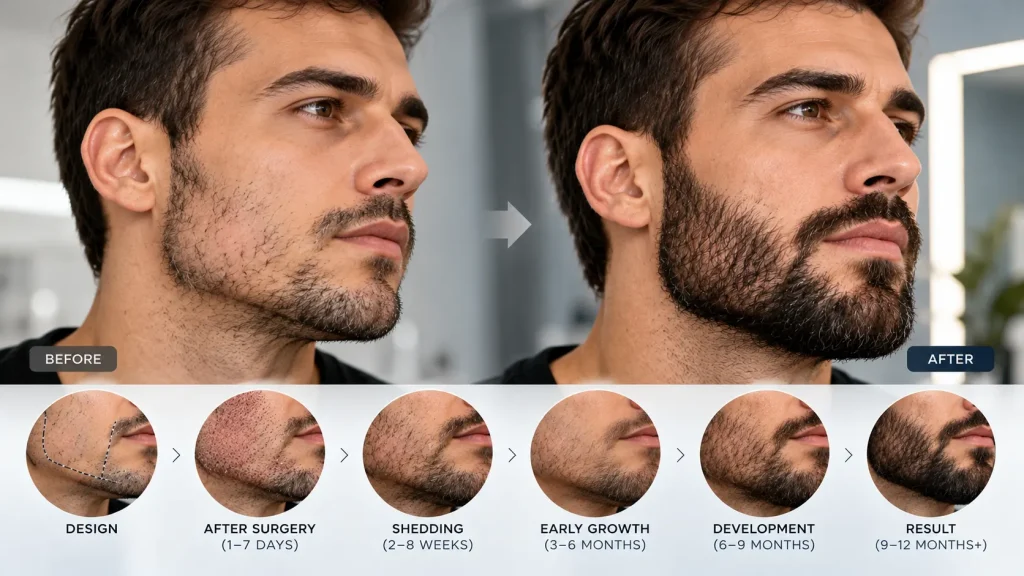
However, a convincing beard hair transplant before-and-after comparison involves more than looking at the final density. It should show the starting beard pattern, the planned design, the early healing phase and the development of new growth over time.
Facial hair grows in different directions across the cheeks, moustache, chin and jawline. The angle and distribution of transplanted follicles therefore play an important role in the appearance of the result. Clinical literature on facial hair restoration discusses graft selection, acute placement angles and aesthetic design as important technical considerations. Read the PubMed review of facial hair in hair restoration surgery for further background.
At City Clinics in London, beard restoration is planned around the patient’s facial features, existing hair and donor supply. The appropriate design and expected coverage should be discussed during an individual clinical assessment.
Beard Transplant Timeline: From Surgery to Visible Results
There is no single timeline that applies to every patient. The following stages provide a general guide to what may happen after a beard transplant. Your treating clinician’s instructions and assessment should take priority over a generic timetable.
Days 1–14: Early healing
The treated area may show redness, swelling, small crusts or tenderness during the initial recovery period. These changes can vary according to the procedure and individual healing response.
Follow the clinic’s instructions for washing, sleeping, physical activity and protecting the grafts. Avoid rubbing, scratching or disturbing the treated area. Contact your clinical team if you develop symptoms that concern you, particularly worsening pain, spreading redness, increasing swelling or signs of infection.
Weeks 2–8: Temporary shedding may occur
Transplanted hair shafts commonly shed during the early weeks after surgery. This can make the beard appear less full than it did immediately after the procedure.
Shedding of the visible hair does not necessarily mean that the transplant has failed. The follicles may remain in place and subsequently produce new hairs. However, healing and growth vary, so concerns about your own progress should be discussed with your clinician.
Months 3–6: Early regrowth may become visible
New hairs may begin to appear over the following months. Early growth can look fine, uneven or patchy, and different areas may develop at different rates.
At this stage, compare photographs with your original baseline rather than expecting a finished beard. Lighting, beard length and grooming can substantially affect how much density appears in a photograph.
Months 6–9: Coverage and texture may develop
Some patients begin to see a more established beard shape as growth develops. The distribution of hair, the direction of individual hairs and the difference between treated and untreated areas may become easier to assess.
Progress at this stage does not determine the final beard density. Your donor hair characteristics, graft survival, natural growth pattern and treatment plan all influence the outcome.
Months 9–12 and beyond: Assessing the result
Growth can continue to develop beyond six months. A more meaningful assessment is often possible around the twelve-month point, although the appropriate review time varies with the individual and the procedure.
Ask your surgeon when your result should be assessed and whether further maturation is expected. Do not treat a general timeline as a deadline by which every graft must have grown.
For guidance on your own recovery and follow-up, consult the City Clinics aftercare information.
Do Transplanted Beard Hairs Fall Out After Surgery?
Yes. Temporary shedding of transplanted hair shafts is a recognised part of the hair-transplant growth cycle. It can be particularly noticeable on the face because the beard is a visible feature and may be difficult to conceal during recovery.
It is important to distinguish early shedding from a confirmed problem with graft survival. A photograph alone cannot establish whether a graft has survived or whether growth is progressing normally.
If you are concerned about persistent gaps, unusual symptoms or a lack of expected progress, contact your treating clinic for an assessment instead of relying solely on comparisons with online photographs.
What Makes a Beard Transplant Look Natural?
Correct hair direction and placement angle
Natural beard hair does not point in one uniform direction. Cheek hair generally follows the growth pattern of that region, moustache hair has its own directional pattern, and chin hair may form distinctive changes in direction.
Transplant planning should account for these differences. Incorrect direction or an unsuitable placement angle can make transplanted hairs more noticeable, even when the overall density appears adequate.
Density that suits the existing beard
The aim is not necessarily to create the highest possible density. The result should take account of the surrounding hair, the desired beard style and the available donor supply.
A gradual transition between existing and transplanted hair may look more harmonious than an abrupt change in density. The achievable result should be explained during the design consultation.
Hair characteristics and facial proportions
Donor hair characteristics influence how transplanted hair blends with existing facial hair. Your facial structure, natural beard pattern and preferred style should also inform the design.
For more information about the procedure and its planning, visit the City Clinics beard transplant page.
How to Evaluate Beard Transplant Before-and-After Photos
Before-and-after photographs can help you understand the range of results a clinic has documented. Their usefulness depends on how transparently the images are presented and whether the cases are comparable.
1. Compare the same angles
Look for front, side and three-quarter views where available. A beard may appear fuller from one angle than another, so a single photograph cannot show the whole result.
2. Check lighting and camera distance
Strong lighting, shadows, image processing and changes in camera distance can alter the apparent density of facial hair. Consistent photographic conditions make comparisons more meaningful.
3. Check beard length and grooming
Longer hair can cover gaps that remain visible when the beard is trimmed short. Compare similar beard lengths and grooming styles wherever possible.
4. Look for a clearly stated time point
A photograph taken three months after treatment should not be compared with a mature result without considering the difference in timing. Look for captions identifying the interval after surgery and whether the image was taken in the clinic or supplied by the patient.
5. Review the starting pattern and graft information
Where available, check the original beard pattern, treated areas and documented graft count. Similar starting patterns may provide a more useful reference than cases with very different donor supply or treatment goals.
6. Look at the entire sequence
Photographs showing the initial design, graft placement and later growth can offer a more complete view of the process than a single final image.
The City Clinics results gallery includes beard-transplant photographs showing stages from design to grown results. Review the accompanying captions to understand the context of each case.
Photographs should be published with appropriate patient consent. Before-and-after images illustrate individual experiences, and results may differ depending on each patient’s circumstances.
Who May Be Suitable for a Beard Transplant?
A beard transplant may be considered by people who want to address patchy facial hair, improve coverage in selected areas or create a more defined beard pattern. Suitability depends on the reason for sparse growth, the donor hair available and the individual’s medical circumstances and expectations.
A consultation should assess:
- The pattern and cause of limited facial hair growth.
- The density and characteristics of the available donor hair.
- The areas to be treated and the proposed beard design.
- The realistic level of coverage that may be achieved.
- Relevant medical history, risks and recovery requirements.
- Whether alternative approaches or further assessment may be appropriate.
A transplant cannot create new follicles from nothing. The amount of coverage that can be achieved is limited by donor supply and other individual factors. A qualified clinician should explain whether surgery is appropriate before a treatment decision is made.
If you are considering treatment in London, the City Clinics beard transplant service provides further information about the procedure and consultation process.
Realistic Expectations: What to Expect From a Beard Transplant
Before-and-after photographs often emphasise successful outcomes, but a balanced assessment should also recognise the limitations of treatment.
- Identical density: not every patient can achieve the same coverage because donor supply and starting patterns differ.
- Immediate growth: transplanted hairs may shed before new growth develops.
- Predictable appearance: No photograph can determine exactly how another person’s beard will look after surgery.
- Freedom from complications: beard transplantation is a surgical procedure and carries risks that should be explained before treatment.
- Unlimited donor supply: donor follicles are finite and should be planned carefully.
A good consultation should explain what may be achievable, what remains uncertain and how the result will be reviewed after treatment.
Questions to Ask Before Choosing a Beard Transplant Clinic
- Can I see documented cases with a starting beard pattern similar to mine?
- When were the after photographs taken?
- Are the photographs clinic-taken or patient-submitted?
- How many grafts are proposed, and why?
- How will the surgeon plan hair direction and density?
- Who will perform the surgical stages?
- What are the main risks and limitations in my circumstances?
- What follow-up appointments and aftercare are included?
- When should my progress and final result be assessed?
- What should I do if growth appears slower than expected?
Compare the complete treatment pathway rather than choosing a clinic solely on the basis of selected photographs or an advertised price.
Frequently Asked Questions About Beard Transplant Results
When do beard transplant results start to appear?
New growth may become visible over the months following surgery, often beginning around the third or fourth month. More noticeable development may occur between months six and nine, but timing varies and the result may continue to mature beyond this period.
Do beard transplants shed before regrowth?
Yes. Transplanted hair shafts commonly shed during the early weeks after surgery. The follicles may remain in place and subsequently produce new hairs. Contact your clinician if you are worried about your recovery or growth.
When can I judge my final beard transplant result?
Around twelve months is a useful general reference for assessing hair-transplant development, but it is not a universal deadline. Your surgeon should advise when your particular beard transplant can be meaningfully assessed.
What makes a beard transplant look natural?
Natural-looking results depend on factors including hair direction, placement angle, graft selection, density, facial proportions and the relationship between transplanted and existing hair.
Can transplanted beard hair be shaved?
Once the treated area has healed and your clinic confirms that shaving is appropriate, transplanted hair can generally be trimmed or shaved. Follow the specific timing and technique provided in your written aftercare instructions.
Will my beard transplant look like the clinic’s before-and-after photographs?
Not necessarily. Photographs show individual results and cannot predict how another patient’s beard will look. The outcome depends on factors such as the initial beard pattern, donor hair availability, treatment design and individual healing response.
Where can I see beard transplant before-and-after results at City Clinics?
Visit the City Clinics results gallery to review published cases and their captions. Ask the clinical team to discuss comparable cases during your consultation.
Can a beard transplant fill patchy cheeks?
A beard transplant may help address selected areas of patchy cheek growth, depending on the cause, donor availability and clinical suitability. A qualified clinician should assess the area and explain realistic treatment options.
Beard Transplant Before and After at City Clinics, London
City Clinics provides beard-transplant information for people considering facial hair restoration in London. The clinic’s published approach emphasises individual beard design, donor planning and the direction and angle of transplanted hair.
Its results gallery presents selected patient photographs, including a beard case sequence from design through placement to grown results. Review the captions carefully and ask which cases are most comparable to your own starting pattern.
Before proceeding, discuss your goals, donor supply, likely coverage, risks, recovery and aftercare with the clinical team. A personal assessment is necessary to determine suitability and develop an appropriate treatment plan.
Considering beard restoration? Visit the City Clinics beard transplant page to learn more about the procedure and consultation process.
City Clinics
82 Harley Street
London W1G 7HN
Telephone: +44 (0)20 7018 9060