Home·Technology
Robotic precision. A surgeon’s hands.
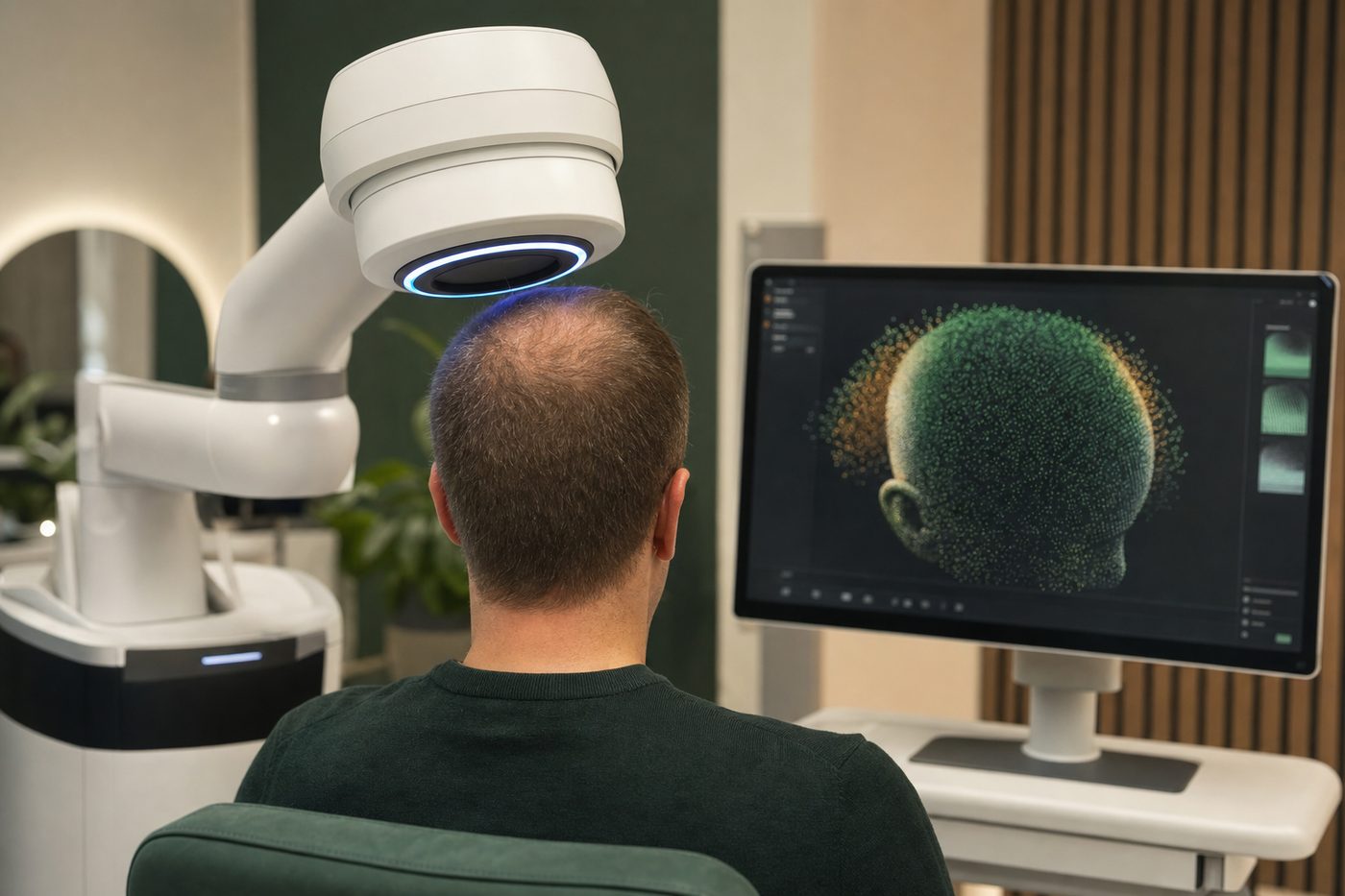
KE-Bot maps every follicle before a single decision is made — then your surgeon reads the data and draws the plan by hand. The film shows the scan exactly as it happens.
The KE-Bot
The scan comes before the conversation.
Most consultations open with an opinion and work backwards to justify it. Yours opens with a record — your scalp captured in full before anyone here tells you what they think. The judgement comes afterwards, and it has to answer to the measurements.
- A record made before any opinion is offered — not after it
- The same map your surgeon designs from, shown to you on screen
- Part of every consultation — included, never an extra
The technology
Planned by technology no other UK clinic has.
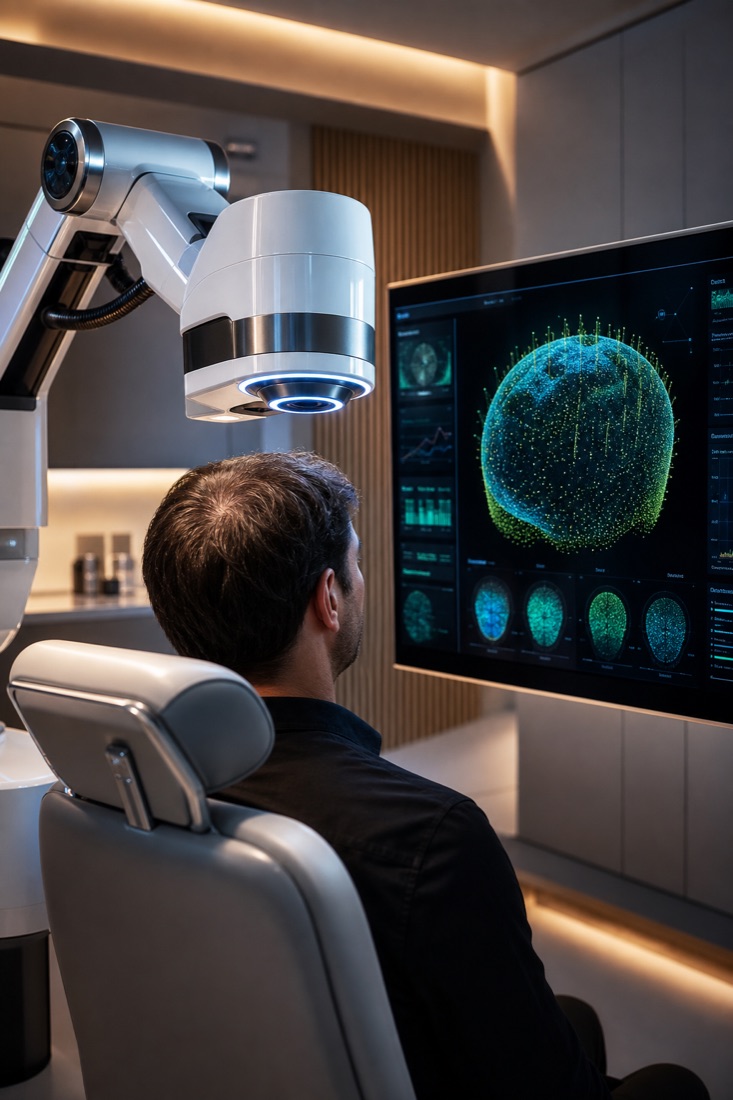
Before a single graft is planned, the KE-Bot builds a complete 3D map of your scalp — measuring what most clinics only estimate by eye. It's the difference between a result that's generic and one that's designed for you.
The only UK clinic planning every case on the KE-Bot robotic platform
 KE-Bot · 360° scanner
Step 1 · the measurement
A 360° scan, before anything is decided
The KE-Bot rotates a high-definition camera array around your entire scalp, capturing it from every angle in a single sitting — the same class of technology used by the world's most respected FUE clinics.
- Every angle captured — hairline, crown, donor and sides
- A complete scalp scan in around 15 minutes
- No guesses, no rough estimates — just tailored accuracy
 3D scalp model
Step 2 · the model
Your scalp, rebuilt in three dimensions
Those images become a precise 3D model of your head — every follicle, its calibre, and the true density and capacity of your donor area, measured rather than assumed.
- Follicle-level density mapping across the scalp
- Your true donor capacity, quantified
- Hair calibre measured, not approximated
 AI analysis
Step 3 · the intelligence
Intelligence that protects your donor area
The AI engine turns the map into hard numbers — graft yields, extraction plans and safe donor limits — so your donor area is never over-harvested and the plan is built on data, not optimism.
- Precise, evidence-based graft-count planning
- Donor area protected from over-harvesting
- Your own data, shared with you — not hidden
 Surgeon-led design
Step 4 · the decision
The machine measures. The surgeon decides.
Your surgeon reads the data and designs your hairline by hand — angles, density zones and a natural shape built around your face. Technology informs the plan; a surgeon owns it.
- Hairline designed personally by your surgeon
- Density mapped to your face shape and age
- One surgeon accountable, start to finish
Your scan, your data
Measured openly. Shared with you.
Your density map, your donor capacity, your graft calculation — walked through with you on screen at consultation. It’s your head; you should see the numbers your plan is built on.
What the scan decides
Three numbers that shape everything.
The scan decides the numbers. The numbers decide the price.
How pricing works →The honest part
The machine measures. It doesn’t operate.
No robot performs your surgery here. The KE-Bot’s job ends where judgement begins — your surgeon reads the data, designs the hairline by hand, and performs every stage of the procedure personally. Technology informs the plan; a surgeon owns it.
Meet the surgeons →
After the scan: the line only a human eye can draw.
About the scan
Asked before every first visit.
Is the scan uncomfortable — does anything touch me?
Do I need to cut or shave my hair for it?
Does the robot perform the transplant?
82 Harley Street · London
Be measured, not sold to.
A fifteen-minute scan, honest numbers, and a plan your surgeon stands behind. That’s how it should begin.
Registered with, members of & regulated by